
Cold Storage Air Curtains: Cut Freezer Room Energy Costs by Up to 40%
How Much Energy Do You Lose Every Time You Open a Cold Storage Door?
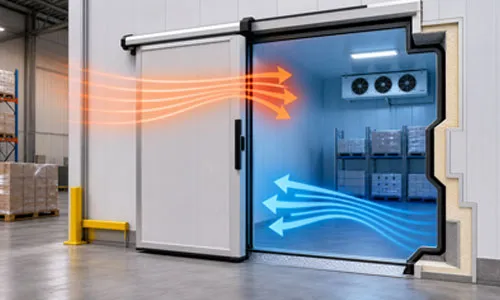
Every time the door opens, warm air rushes in, temperature rises, and the refrigeration system kicks in to pull it back down. Hundreds of times a day, the same cycle repeats hundreds of times.
The result: high energy bills, accelerated equipment wear, and goods damaged by temperature fluctuations.
A cold storage air curtain solves exactly this problem. When correctly installed, it reduces heat exchange by up to 80% every time the door opens.
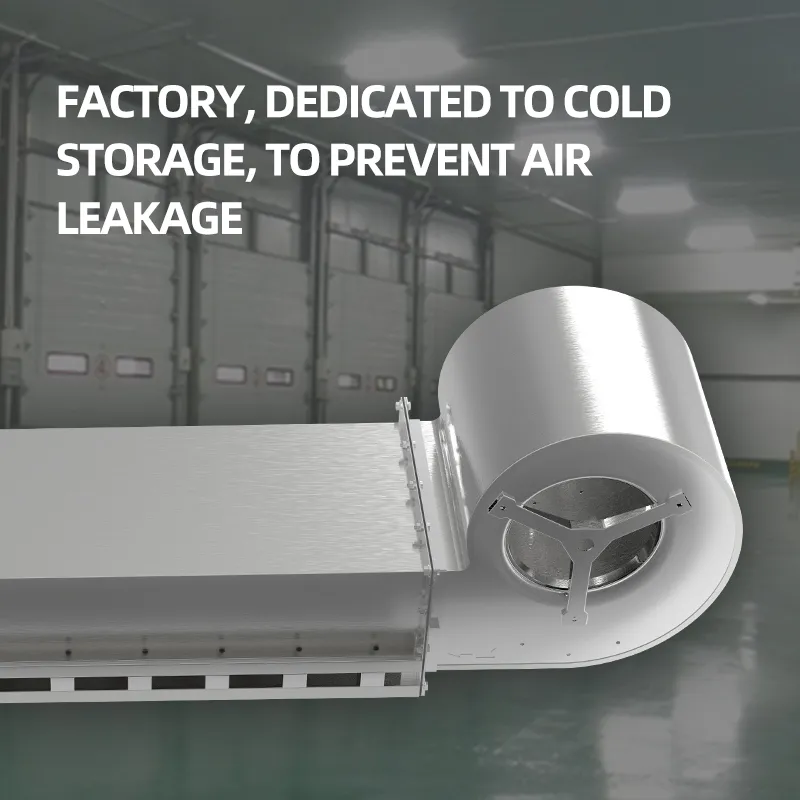
What Makes a Freezer Room Air Curtain Different from a Standard One?
Many people assume any air curtain works in any setting — just install it and go. In cold storage environments, that assumption is expensive.
Cold storage-specific models have three core differences:
Handles extreme temperature differentials. The gap between inside and outside can exceed 60°C. Dedicated models use motors, impellers, and housings built for low-temperature operation — designed to run reliably under these conditions long-term.
Anti-frost design. In a cold storage environment, the air outlet of a standard air curtain freezes over quickly. Dedicated models have built-in anti-frost structures that keep the outlet clear.
Optimized airflow angle. The airflow is angled slightly inward, actively pushing infiltrating warm air back outside — not just forming a passive barrier.
One hard rule to remember: for freezer rooms below -18°C, you must use a low-temperature anti-frost model. For projects with unusual door sizes, extreme temperature differences or special installation requirements, HUANGXI can also provide customized air curtain solutions based on your cold storage layout.
The wrong model will significantly reduce energy-saving performance.
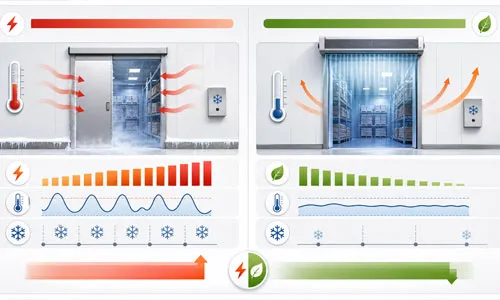
Cold Storage Air Curtain Energy Data: What Does 80% Less Heat Loss Actually Mean?
| Metric | Without Air Curtain | With Air Curtain |
| Temperature fluctuation at door | 4–10°C | Under 1°C |
| Cold air infiltration | Baseline | Reduced 60%–80% |
| Overall refrigeration energy use | Baseline | Reduced 20%–40% |
| Daily defrost cycles | 3–4 times | 1 time |
| Payback period | — | 8–17 months |
Research by UK academic A.M. Foster, focused specifically on heat infiltration through cold storage doors, shows that cold storage air curtains can reduce cold air infiltration by 60% to 80% — making them the highest return-on-investment option among all cold storage energy-saving solutions.
The drop in defrost frequency is especially significant. Defrosting isn’t just wasted electricity — every defrost cycle forces the temperature up, the refrigeration system works to recover it, and goods go through another round of temperature fluctuation. Going from 4 defrost cycles per day down to 1 means dramatically more stable conditions all day, with a direct impact on food shelf life.
Cold Storage Retrofit Case Studies: Real Energy Savings from Europe to the Middle East
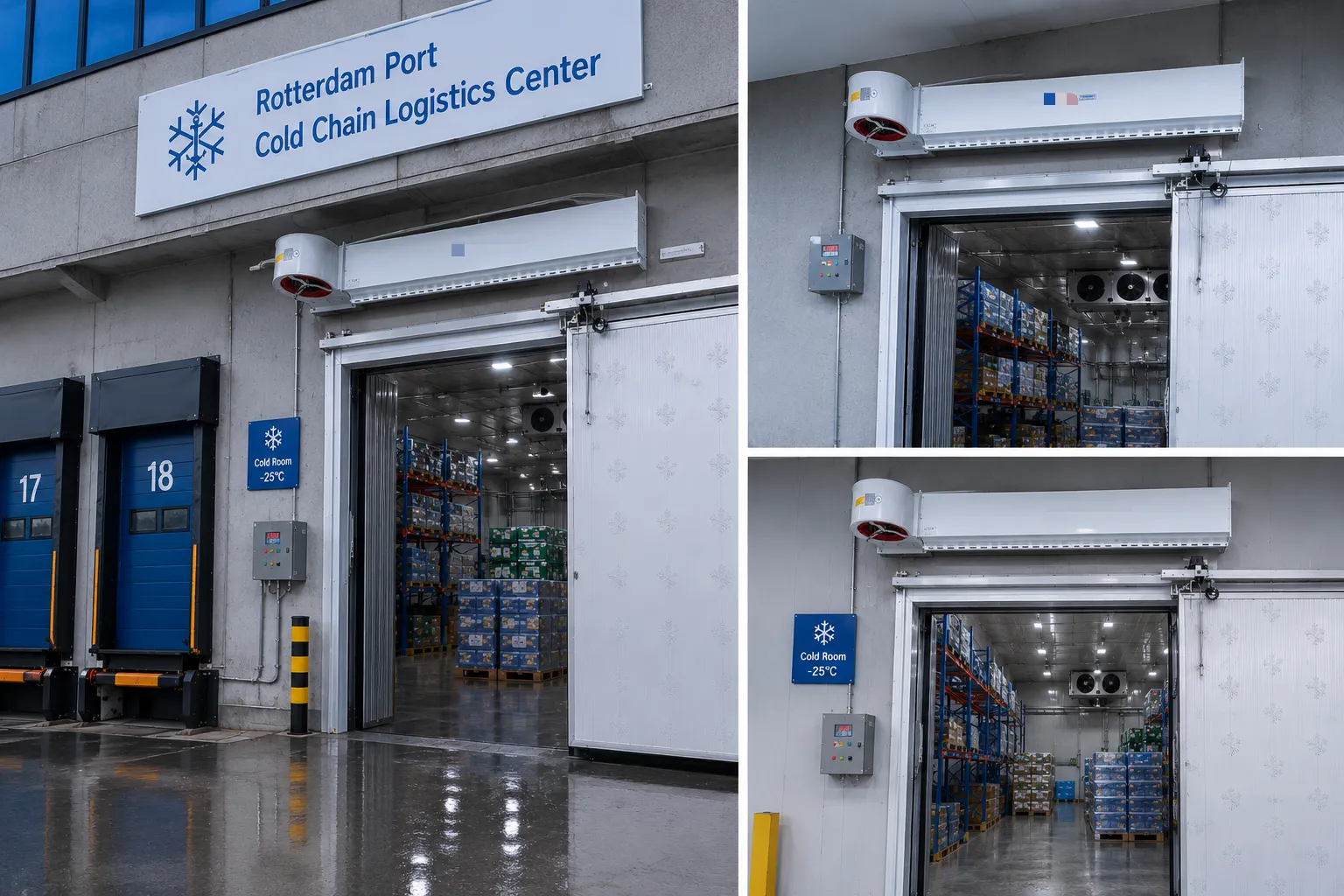
Rotterdam Port Cold Chain Logistics Center, Netherlands
(Storage temp: 0–4°C / Average 600 door openings per day)
In summer, temperature fluctuations near the door reached 8°C. Floors were constantly wet with condensation, forklift slip accidents were frequent, and refrigeration unit maintenance costs ran 30% over budget every year.
After installing horizontal air curtains:
- Door-area temperature fluctuation dropped to under 1.5°C
- Floor condensation was largely eliminated
- Monthly energy consumption fell by 27%
- Energy savings over the first summer covered 60% of installation costs
Melbourne Meat Processing Plant Freezer Room, Australia
(Storage temp: -18°C / Around 200 door openings per shift)
The evaporator required defrosting 4 times per day. Each defrost cycle pushed the temperature up by about 5°C, seriously affecting meat color and freshness. Annual product losses were estimated at over AUD 20,000.
The retrofit used a double-sided installation: a low-temperature centrifugal air curtain on the inside, a high-velocity auxiliary model on the outside, creating a dual barrier.
Post-installation results:
- Daily defrost cycles dropped from 4 to 1
- Storage temperature held stable at -18°C all day, fluctuation under 1°C
- Heat exchange reduced by over 80%
- Equipment maintenance costs down 35%
- Payback period: 11 months
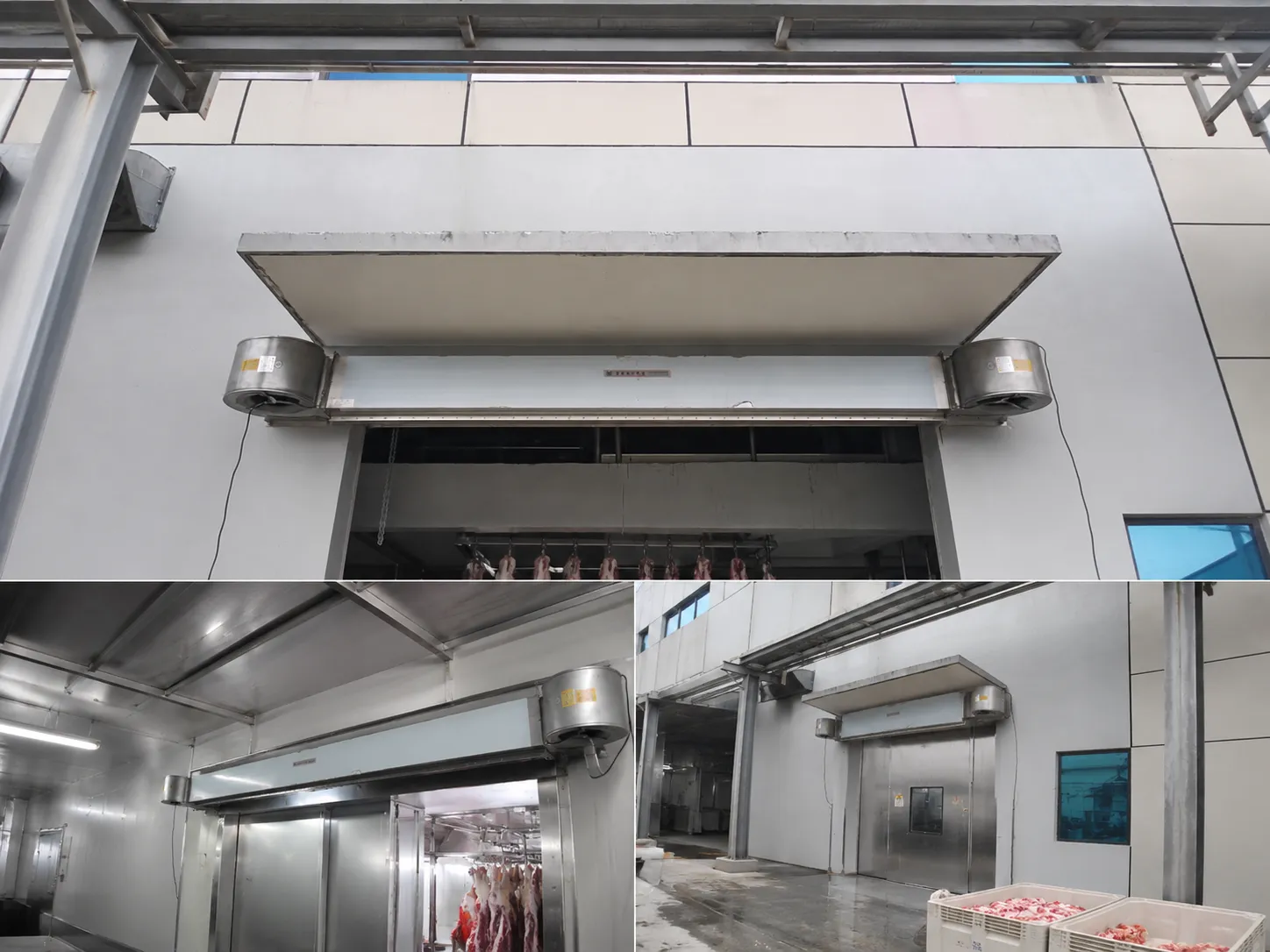
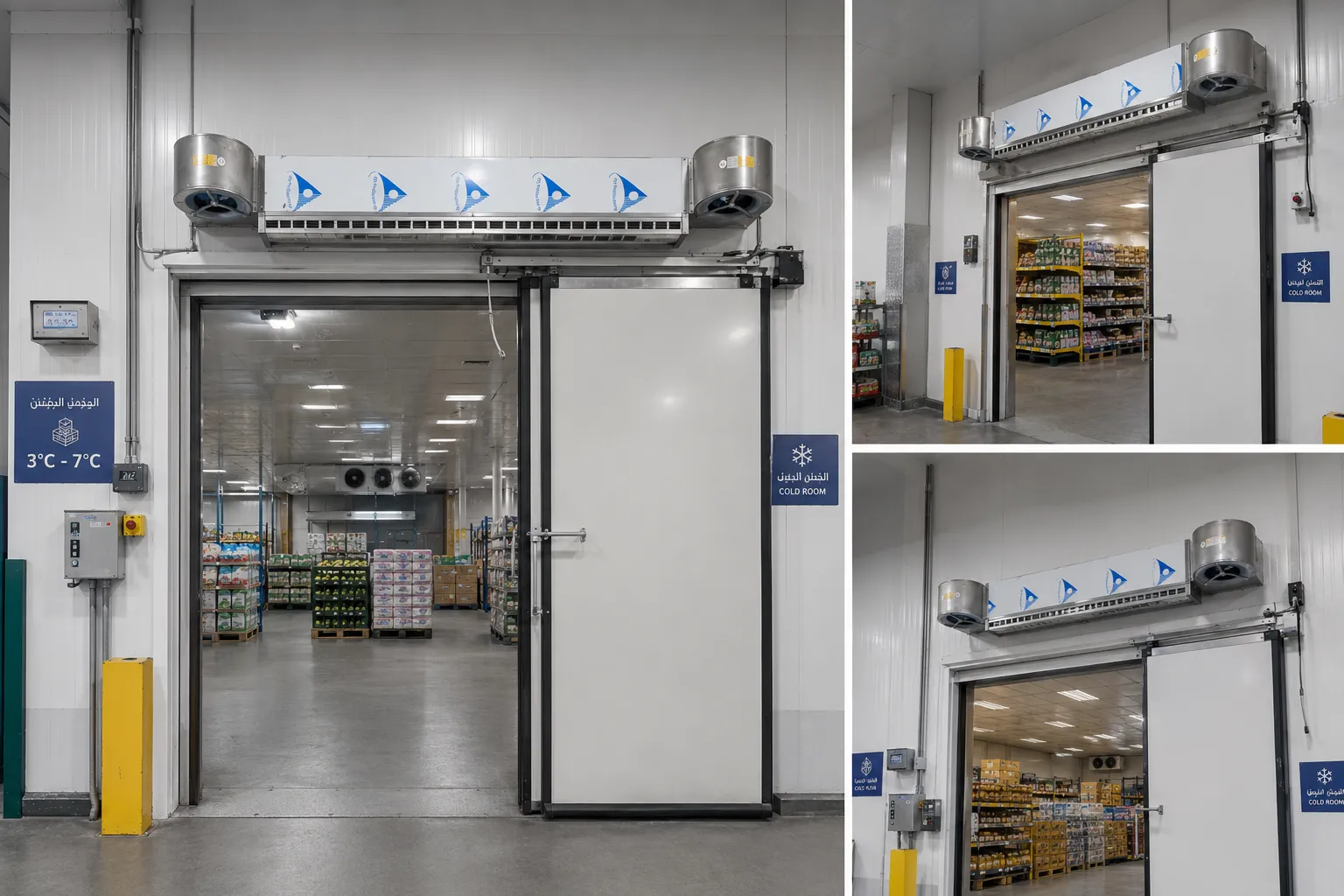
Large Supermarket Cold Storage Area, Riyadh, Saudi Arabia
(Outdoor temp up to 45°C / Average 800 door openings per day)
The refrigeration system ran at near full capacity almost around the clock. Energy costs were 1.8 times higher than equivalent European facilities. Products near the door consistently had shelf lives 15% to 20% shorter than expected.
After installing high-velocity air curtains with door interlock automatic control:
- Refrigeration energy consumption down 38%
- Product loss rate reduced by 12%
- Annual energy cost savings of approximately USD 48,000
- Payback period: 14 months
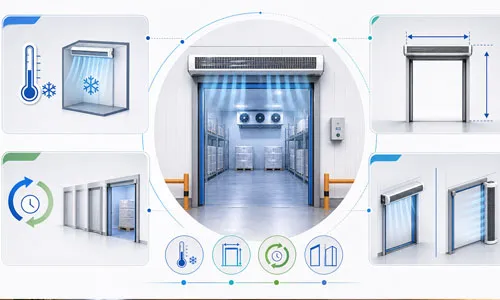
Cold Storage Air Curtain Selection Guide: 4 Key Parameters That Determine Energy Savings
Confirm your storage temperature. Below -18°C, a low-temperature anti-frost dedicated model is a hard requirement — standard cold storage models are not a substitute.
Measure your door dimensions. Door width determines coverage length. Door height affects airflow velocity requirements. Incomplete coverage is as good as no coverage.
Assess door opening frequency. If daily openings exceed 300, choose a high-velocity model and pair it with door interlock automatic control.
Choose the right installation method. Standard doors: horizontal installation above the door. Extra-wide doors: consider vertical installation with one unit on each side, especially for large openings where industrial air curtains provide stronger airflow coverage.
For food processing areas, humid environments, or facilities requiring easier cleaning, a stainless steel air curtain may also be considered depending on the installation environment.
Not sure which model fits your operation? Tell HUANGXI your storage temperature, door dimensions, and daily opening frequency — we’ll provide a selection report and estimated energy savings.
Cold Storage Energy Savings Start at the Door — HUANGXI Helps You Calculate Exactly How Much
70% of cold storage energy problems happen at the door. An air curtain is not an add-on — it is the fastest-payback component in any cold chain temperature control system.
80% reduction in door heat loss. 40% drop in refrigeration energy consumption. These figures have been verified across facilities of different sizes in different countries.
HUANGXI provides customized selection solutions. Tell us about your cold storage operation — we’ll help you work out exactly how much you can save each year.
FAQ
Q1: Are cold storage air curtains suitable for all types of cold storage?
Suitable for the vast majority of applications, including cold rooms (0–5°C), freezer rooms (below -18°C), and ultra-low temperature storage. The key is choosing the right model. Below -18°C, you must use a low-temperature anti-frost dedicated model — standard models will freeze up and fail quickly.
Q2: Can forklifts still operate normally after installation?
Completely unaffected. The airflow does not obstruct movement. With less floor condensation and better visibility, operational safety actually improves. No adjustments to workflow are needed after installation.
Q3: Which is better for cold storage — an air curtain or a plastic strip curtain?
Plastic strip curtains cost less upfront, but frequent forklift traffic damages the strips and replacement costs accumulate continuously. Air curtains allow completely unobstructed movement, with more consistent energy-saving performance. In high-frequency operation environments, the total cost of ownership is lower. Many large cold storage facilities use both: air curtains as the primary thermal barrier, plastic strip curtains as a supplementary backup.