Air Curtain Energy Efficiency: Cut HVAC Energy Loss
Air Curtain Energy Efficiency: Cut HVAC Energy Loss Open doors can increase HVAC energy use.…


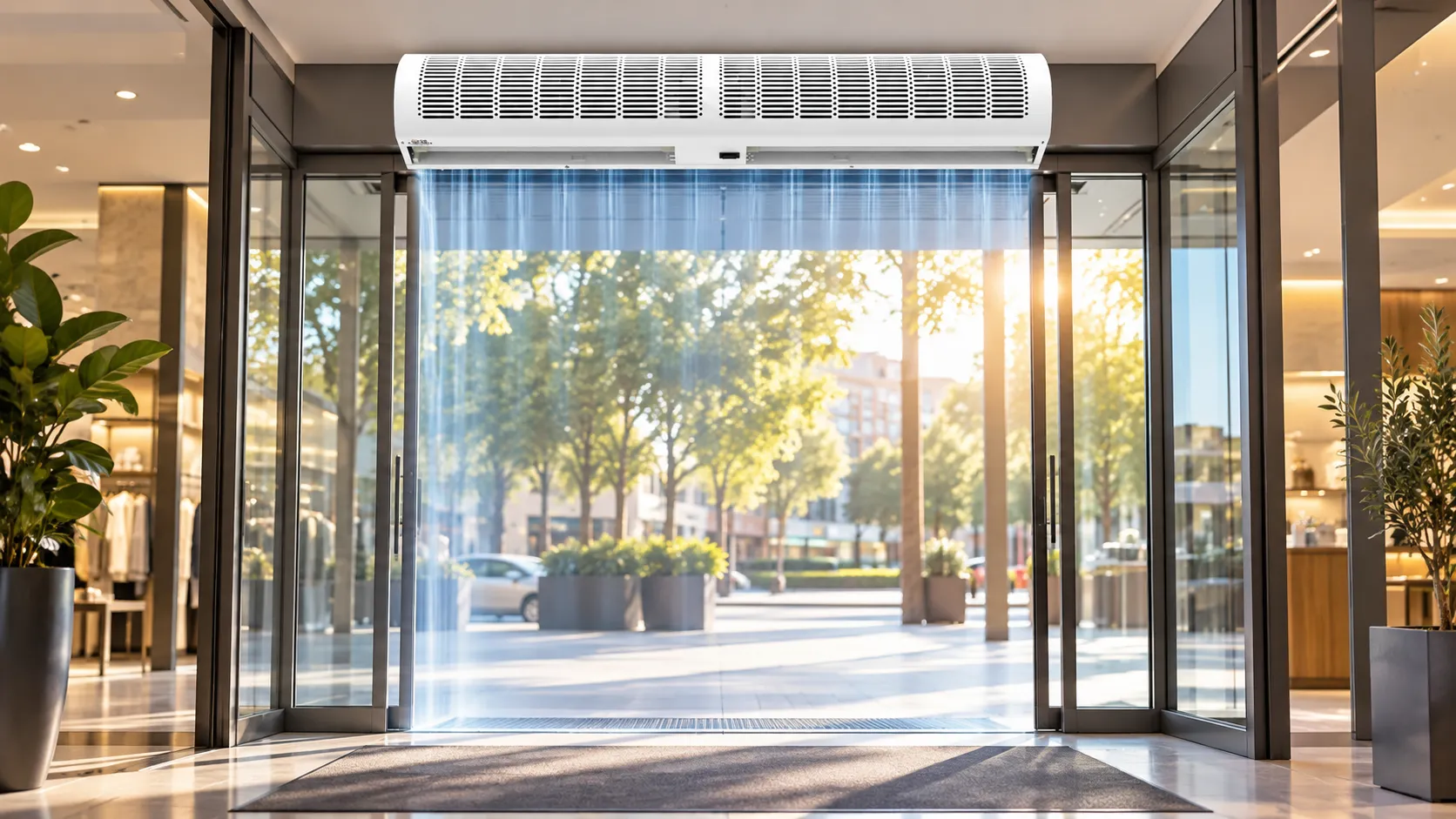
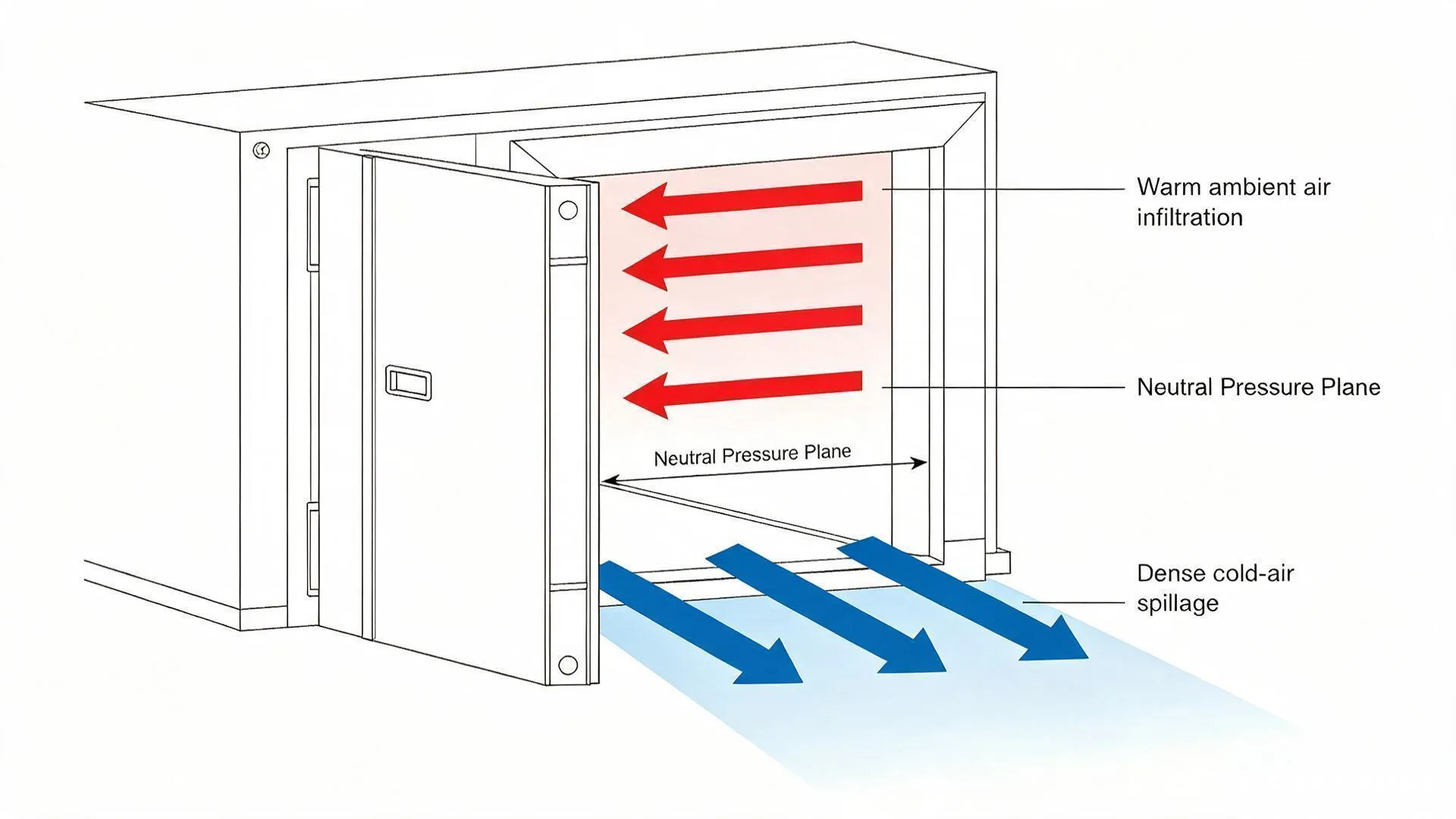
When a cold-room or freezer door opens, the air on each side does not remain in place. Dense cold air tends to spill outward through the lower part of the opening, while warmer air flows inward above it. Wind, pressure imbalance and moving forklifts can intensify that exchange. A centrifugal air curtain for cold storage creates a high-momentum plane jet across the doorway to reduce this uncontrolled flow while leaving the opening physically clear.
The word “centrifugal” describes the fan arrangement, not a guaranteed cold-room result. Effective separation depends on the complete unit: the impeller and casing, discharge nozzle, velocity uniformity, jet thickness, angle, mounting position, controls and the conditions at the doorway. This article explains that system using cold-storage physics rather than a universal savings claim.
Air density increases as temperature falls, all else being equal. When a tall opening connects a cold room with a warmer area, the pressure difference varies with height. A neutral region forms where the pressures are approximately equal. Below it, heavier cold air tends to move out; above it, lighter warm air tends to move in.
This exchange carries two forms of refrigeration load:
The latent component also creates operational problems. Moisture can appear as fog in the mixing zone, water or ice on floors and door surfaces, and frost on evaporator coils. The air curtain’s first job is therefore not to “make cold air.” It is to reduce the mass of warm, humid air crossing the opening.
The industry guide from the UK HEVAC Air Curtain Group describes the large temperature and density difference that drives exchange whenever a cold-store door opens. AMCA’s more recent article on optimizing cold-storage environments with air curtains likewise identifies humidity infiltration, ice buildup and increased defrost cycling as linked doorway problems.

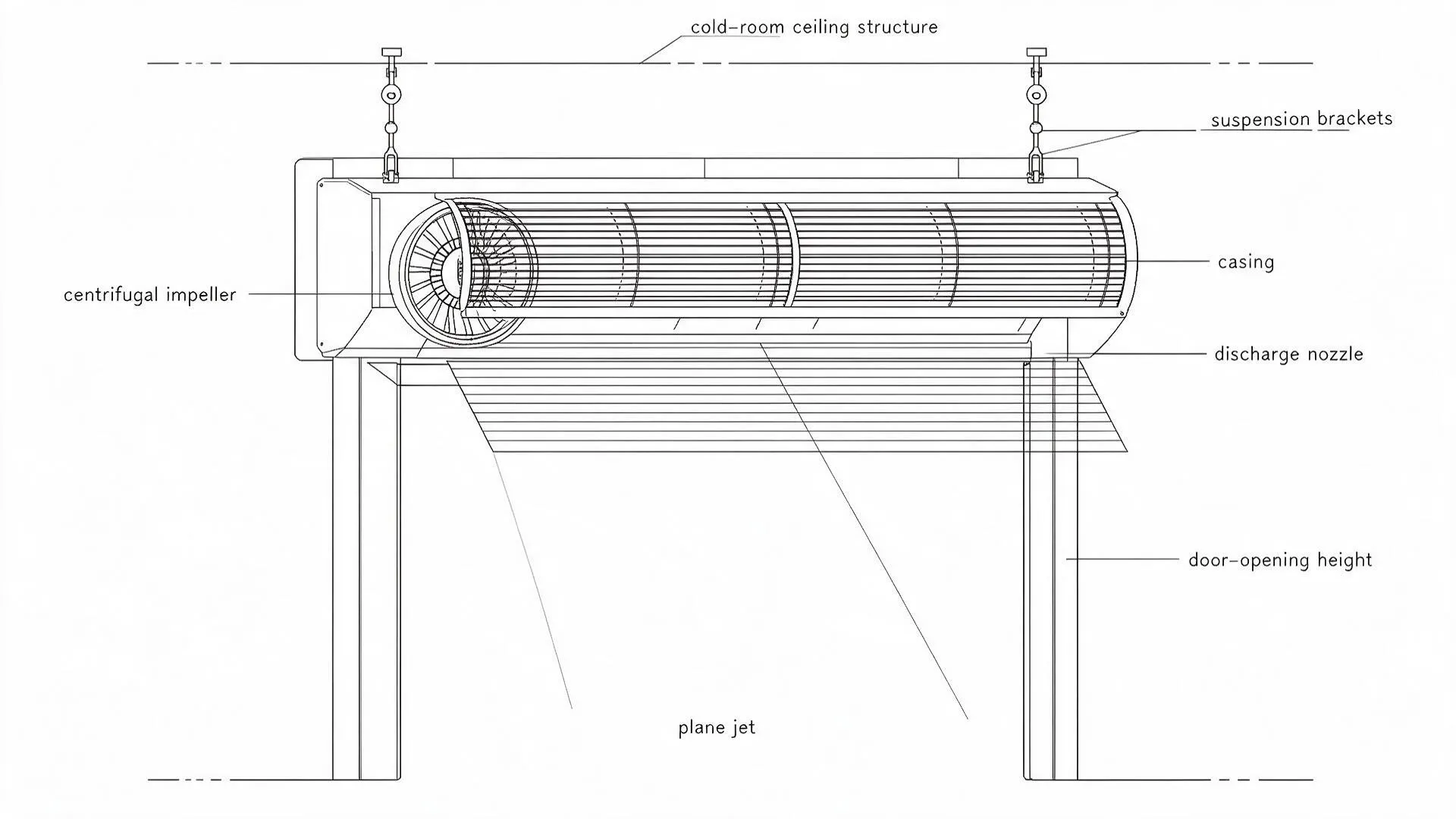
In a centrifugal fan, air enters the impeller approximately along its axis and leaves radially into a casing that directs it toward the outlet. This architecture can provide useful pressure capability and a controlled discharge in a compact air-curtain housing. It is often selected where the nozzle must produce a fast, reasonably uniform jet.
However, a fan cannot be judged by type alone. The U.S. Department of Energy’s fan-system sourcebook explains that airflow, pressure, efficiency and power are connected through the fan curve and system operating point. Impeller diameter, rotational speed, casing geometry and inlet/outlet restrictions all affect the result.
A “centrifugal air curtain” should therefore be evaluated using the assembled unit’s aerodynamic data, not a generic statement that centrifugal fans create more pressure.
The discharge leaves the nozzle as a sheet of moving air. As it travels, it entrains air from both sides, spreads and slows. Temperature difference can bend it toward the less-dense side; pressure and wind can bend it in either direction. If the jet misses its designed terminal point or breaks away from the opening plane, uncontrolled exchange increases.
Three jet characteristics matter:
ANSI/AMCA Standard 220-21 establishes laboratory methods for rating air-curtain aerodynamic performance. For a cold-store project, ask for tested airflow, outlet-velocity uniformity, power and projection data at the proposed operating speed.
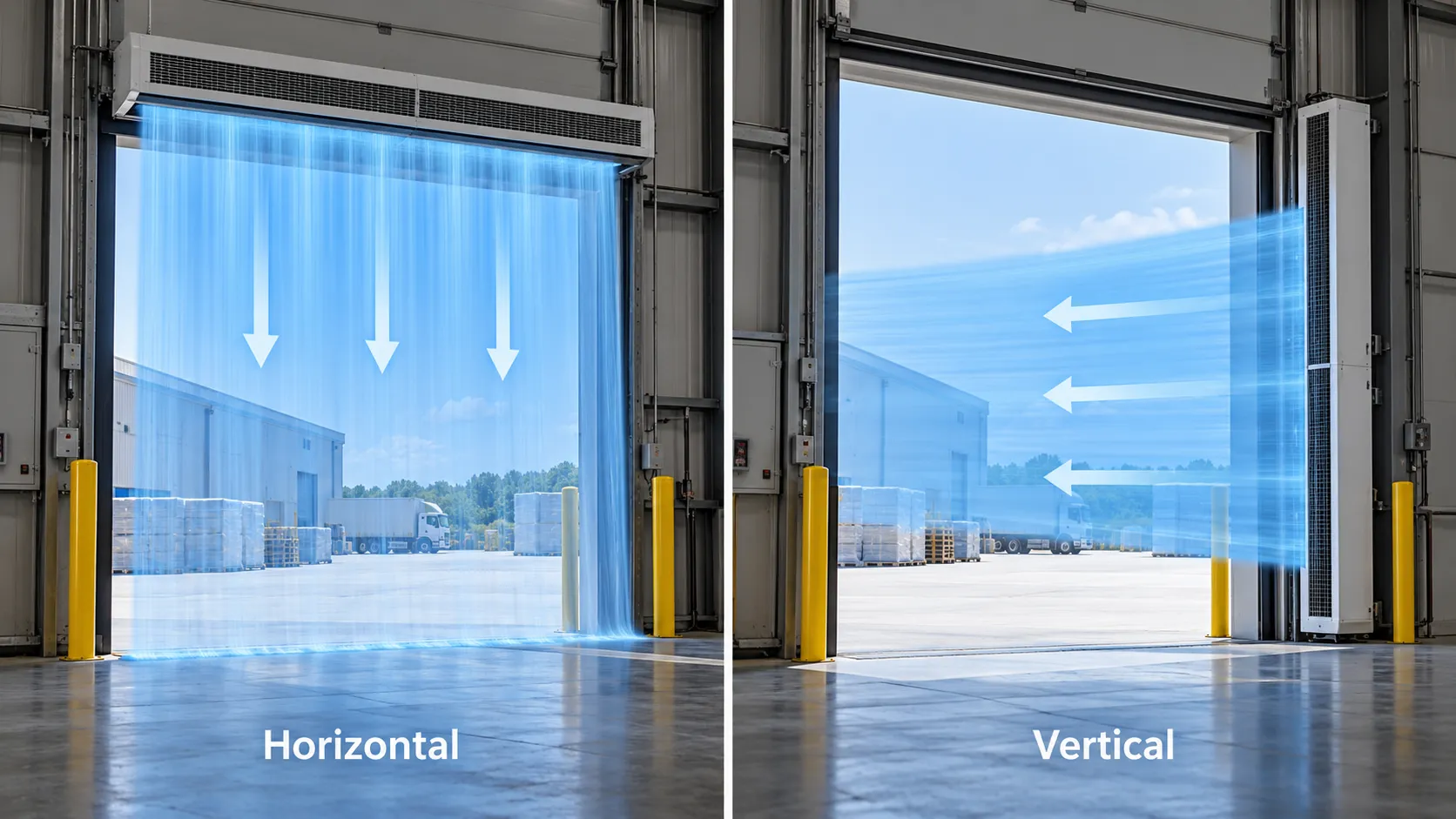
A perfectly vertical jet is not always the stable setting. The discharge may need a controlled angle to balance the dominant pressure and density force. Too little correction can allow the jet to bend into the cold room. Too much can push conditioned air out or create excessive mixing.
The correct direction cannot be chosen from temperature difference alone. Exhaust systems, evaporator fans, adjacent doors and outdoor wind can change the pressure field. Commission the angle and speed with the building in representative operation, including the door sequence and typical traffic.
A laboratory and numerical study of aerodynamic sealing at a cold store evaluated sealing at different jet velocities, illustrating why performance has an operating range rather than increasing indefinitely with fan speed.
An undersized jet can be swept aside. An excessively strong or badly aimed jet can increase entrainment, disturb the room and consume unnecessary power. Fan affinity relationships also mean that raising rotational speed can cause power to rise much faster than airflow. The optimum is the lowest stable duty that maintains the required barrier under design conditions, with an appropriate safety margin.
Variable speed can be useful when the doorway experiences different modes—for example, a lower-disturbance transfer period and a wind-exposed loading period. Each set point should be commissioned, not left as an arbitrary percentage on a controller.
A cold-storage air curtain does not eliminate the value of a physical door. The closed door provides the strongest thermal and vapor separation. The air curtain limits exchange during opening and may support surface drying in a defined post-close sequence. A high-speed door reduces exposure time; an interlocked air curtain reduces exchange during that time.
A practical sequence can include:
Coordinate the air curtain with door safety devices, the BMS and fire/emergency logic. A timer added without understanding the cause of condensation can waste energy or move moisture to another surface.
| Input | Required detail | Engineering purpose |
|---|---|---|
| Opening | Clear width and nozzle-to-floor height | Defines coverage and jet projection |
| Temperatures | Design temperature on both sides | Indicates density difference and sensible load |
| Humidity | Warm-side design humidity and seasonal range | Indicates moisture and frost risk |
| Pressure | Exhaust, make-up air, evaporator airflow and adjacent doors | Identifies cross-opening force and jet direction |
| Traffic | Vehicles, loads, speed, cycles and open time | Defines disruption and recovery duty |
| Environment | Condensation, washdown, corrosion and cleaning method | Determines materials and protection |
| Electrical | Voltage, frequency, phase and controls | Prevents an incompatible motor package |
The catalog identifies single-motor LFM250/LFM280, dual-motor LFM250S/LFM280S, top-fan LFM250T/LFM280T and inner-rotor LFM260 centrifugal families. Listed input is 380 V, 50 Hz; shown airflow spans about 1,510–7,200 m³/h and catalog wind-speed values about 14.5–23 m/s. Housing options include spray-painted material, 201 stainless steel and 304 stainless steel, with pure-copper motors.
These are catalogue ratings, not universal freezer approval. The catalog does not state a minimum operating temperature, IP rating, low-temperature lubricant, heater or 60 Hz option. Mexico and Brazil projects therefore need written confirmation for the exact motor, controls, frequency and cold-room temperature.
The HUANGXI cold-storage air curtain page introduces the current application category, while the LYB centrifugal air curtain page shows how a centrifugal platform can deliver a controlled high-velocity discharge in commercial and industrial environments. A cold-store proposal must still confirm that the exact motor, materials, temperature rating and electrical configuration are approved for the project.
For large vehicle openings, compare the cold-store requirements with the industrial air curtain range. For background on infiltration-related energy, see HUANGXI’s air-curtain energy mechanism. Final savings should be calculated from project data rather than copied from a general case.

A centrifugal fan can provide the pressure and flow needed to form a useful jet, but the fan label does not prove doorway separation. The complete air curtain must cover the opening, project to its terminal point, resist the actual pressure forces and recover after traffic. Controls and commissioning determine whether that aerodynamic potential becomes reliable operation.
For an engineering selection, send HUANGXI the door dimensions, temperatures and humidity on both sides, traffic profile, wind and pressure information, installation constraints and complete electrical supply. Those inputs allow the manufacturer to propose a catalog-verified cold-storage configuration.
Not necessarily. Many systems use unheated ambient or room-side air to create the separating jet. The correct source and arrangement depend on the temperatures, condensation objective and manufacturer design.
A centrifugal architecture can provide useful pressure capability and direct air through a defined casing and nozzle. Actual suitability depends on the assembled unit’s tested flow, velocity uniformity, projection and environmental rating.
No practical open-door system should be described as perfectly airtight. The objective is to reduce exchange. Performance varies with pressure, wind, traffic, installation and operating set point.
Usually the closed physical door provides the main barrier. A defined delay may be used for drying or control reasons, but continuous operation should be justified from the project conditions and manufacturer’s sequence.