Air Curtain Energy Efficiency: Cut HVAC Energy Loss
Air Curtain Energy Efficiency: Cut HVAC Energy Loss Open doors can increase HVAC energy use.…

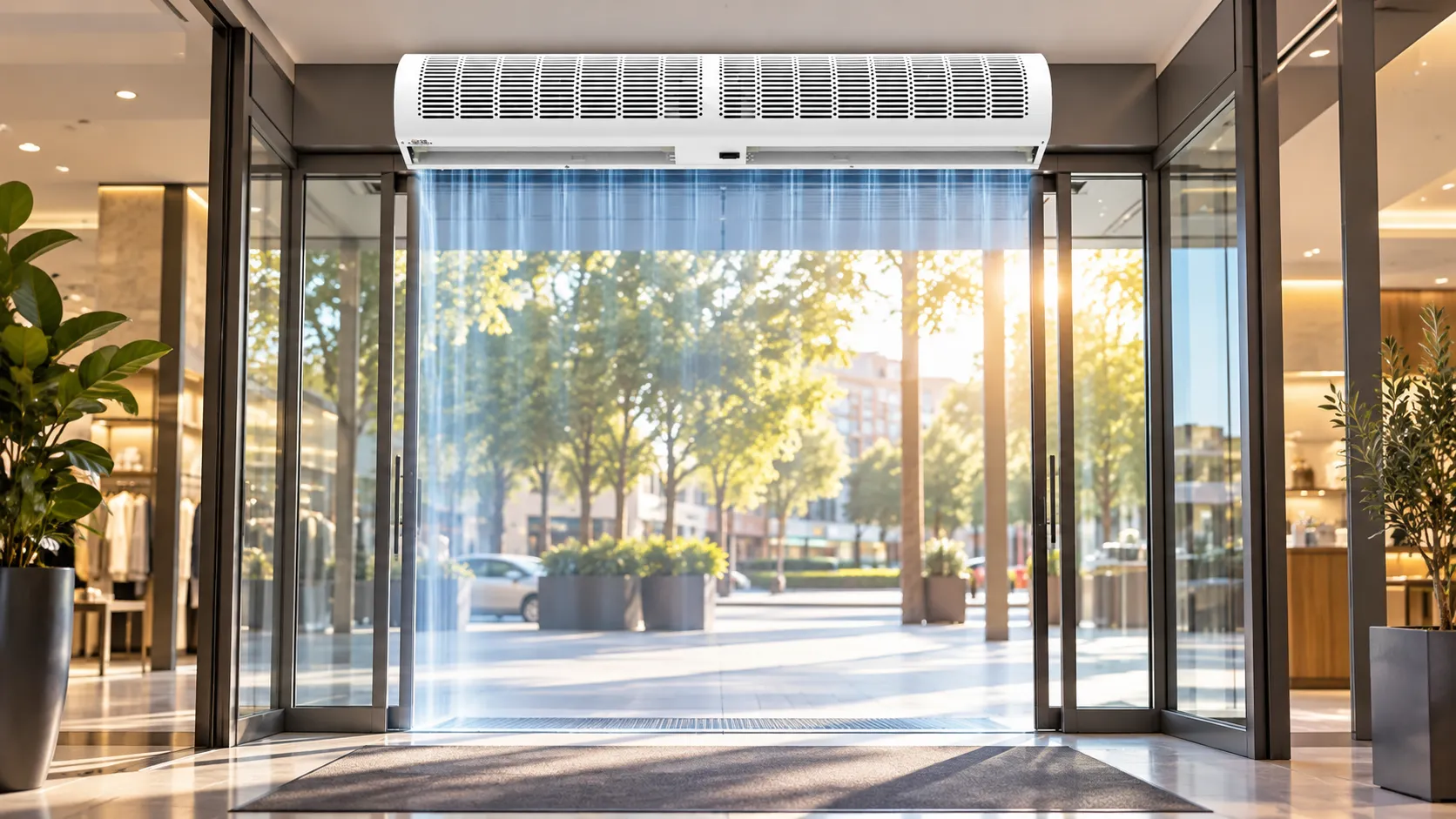
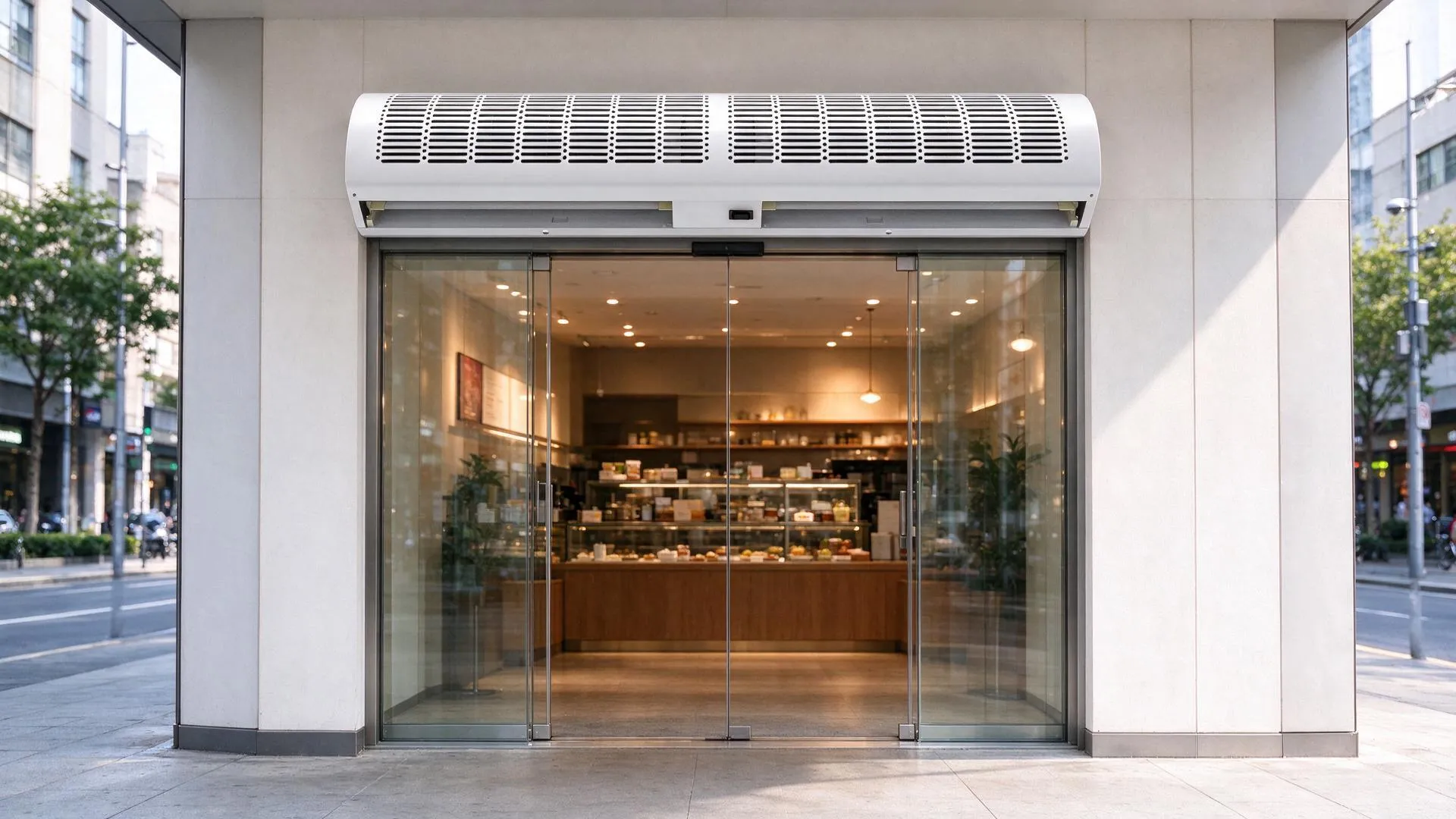
The core function is environmental separation. ASHRAE describes air curtains as controlled barriers used for environmental and thermal separation and resistance to wind at open doors. In commercial buildings, that can help stabilize entrance comfort, reduce drafts, limit infiltration and support HVAC operation while the entrance remains accessible.
For technical background, see the ASHRAE air curtain guidance. It emphasizes opening dimensions, air velocity projection and the influence of wind and building pressure.
A commercial air curtain should therefore be treated as air-distribution equipment. The fan, nozzle, motor, cabinet, mounting height and surrounding pressure field act together as one system.
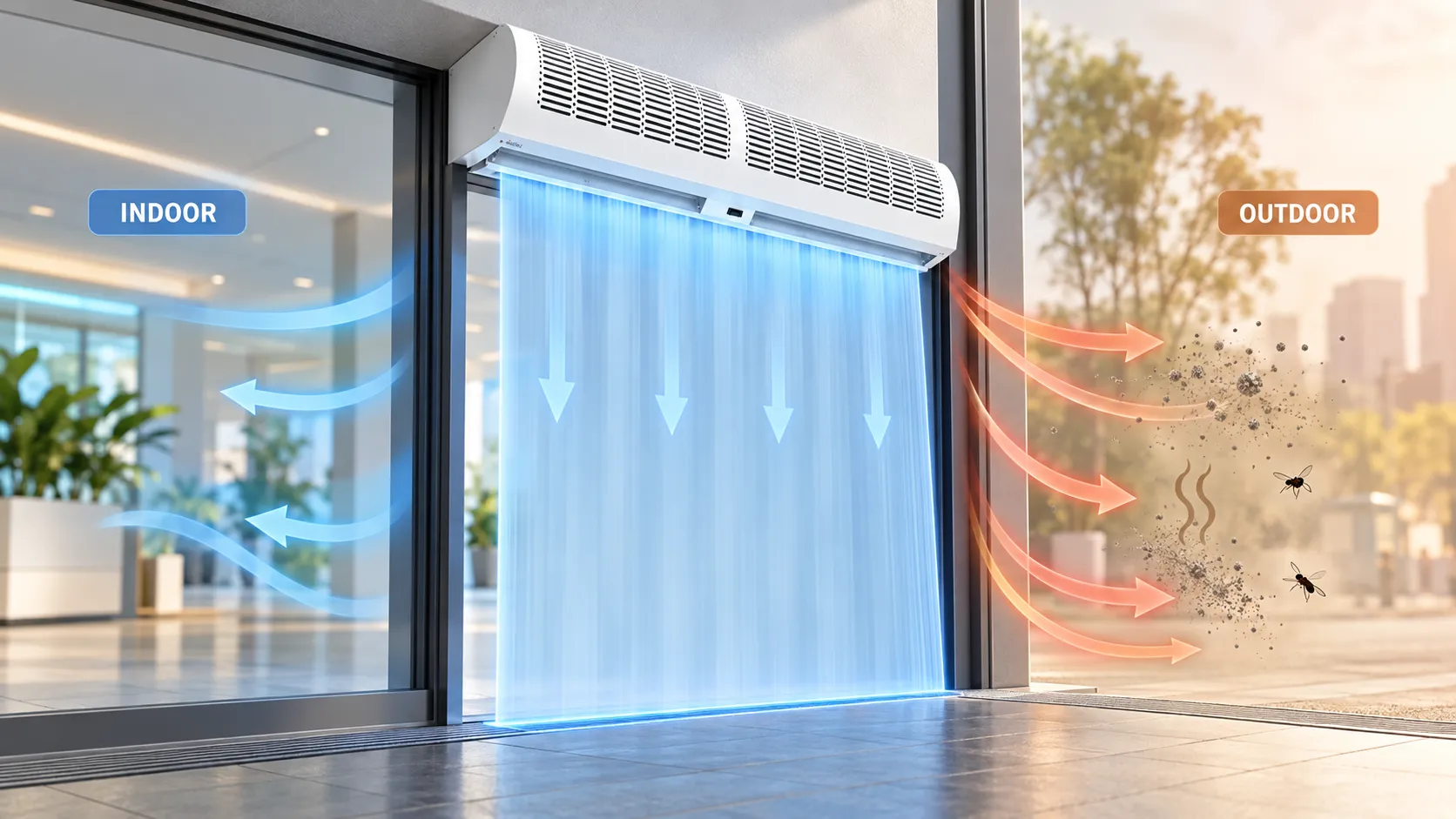
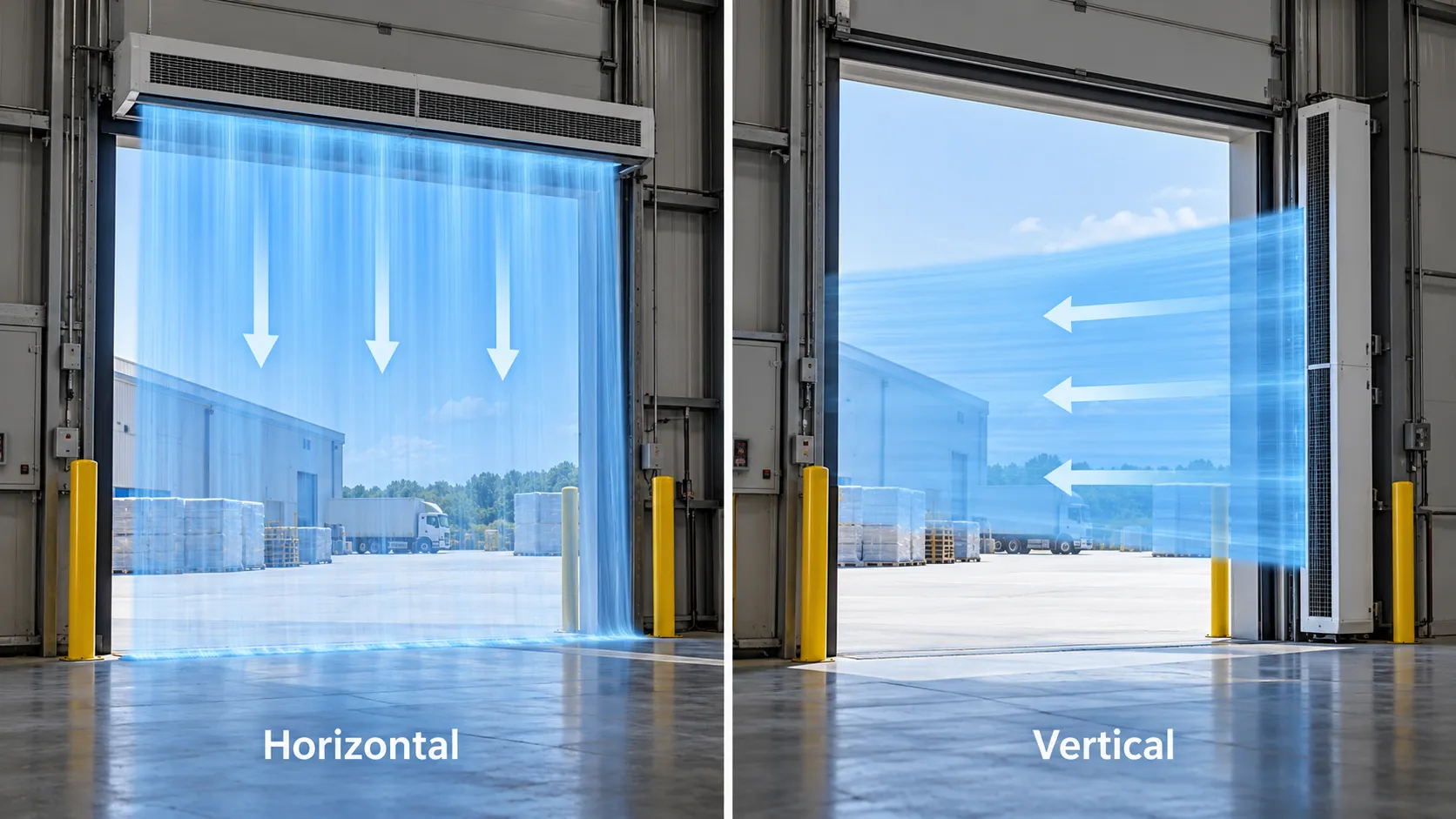
An air curtain works by generating a coherent high-velocity planar jet across an opening. The jet must retain enough momentum to resist buoyancy-driven exchange, wind pressure and mechanical pressure differences while remaining stable and comfortable. Its effectiveness depends on width coverage, installation height, nozzle geometry, discharge angle, airflow volume, outlet velocity and the pressure field around the doorway.
As the jet travels downward it entrains surrounding air and loses momentum. The designer must make sure the stream still has useful velocity at the lower part of the doorway. If the jet is too weak it bends away from the opening and lets air exchange around it. If it is too strong, it may create discomfort, noise and unnecessary power consumption.
The ideal jet is continuous across the opening, directed slightly toward the side where pressure tends to push it, and free from obstructions such as signs, beams or door hardware.
Width is the first selection dimension because the air curtain must cover the opening. The cabinet should match or slightly overlap the clear doorway width. A shorter unit can leave unprotected zones at the edges where infiltration continues.
For wide doors, multiple units can be installed side by side if the manufacturer permits. The installation should minimize gaps between discharge sections so the barrier behaves as one continuous plane of air.
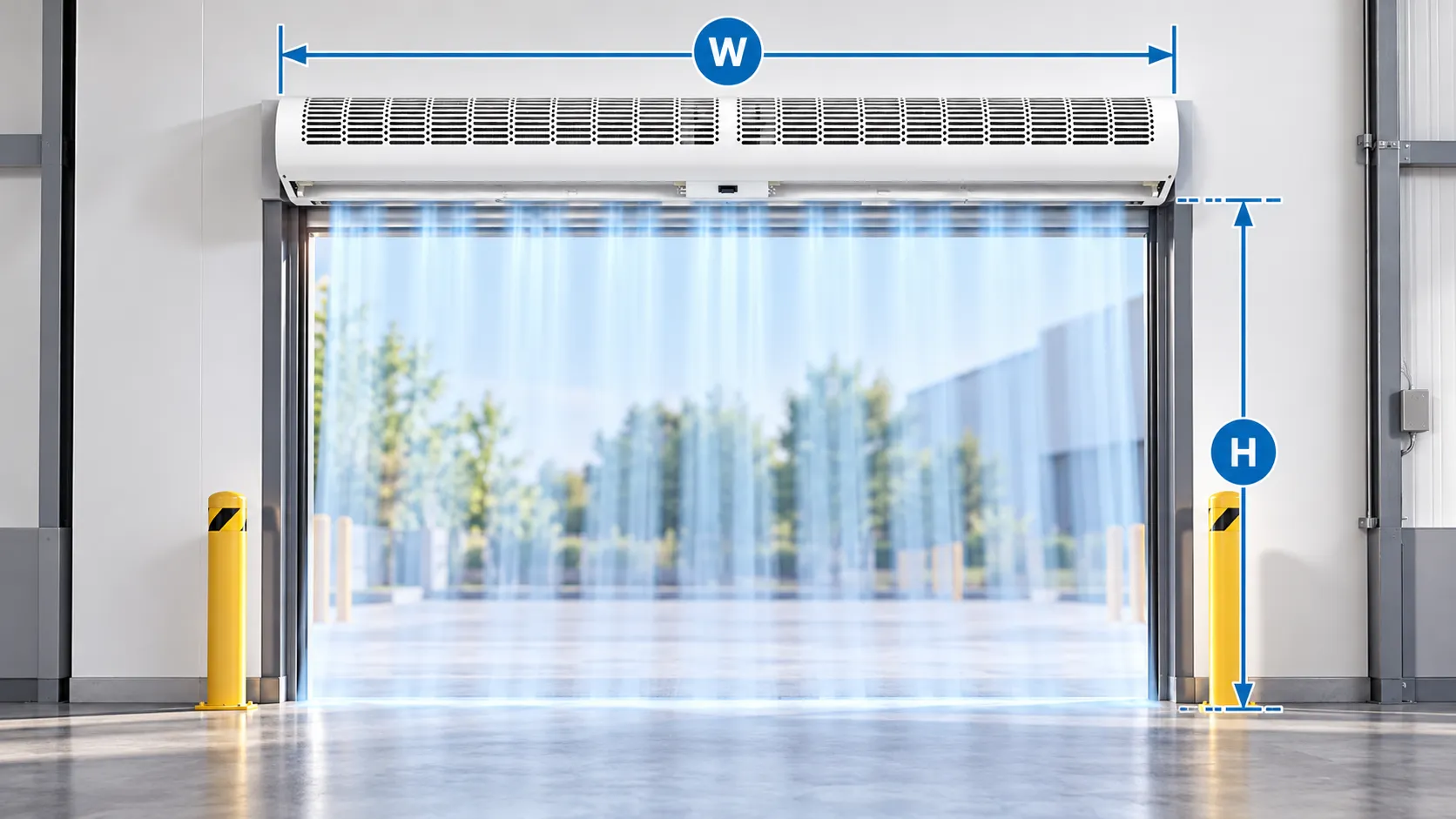
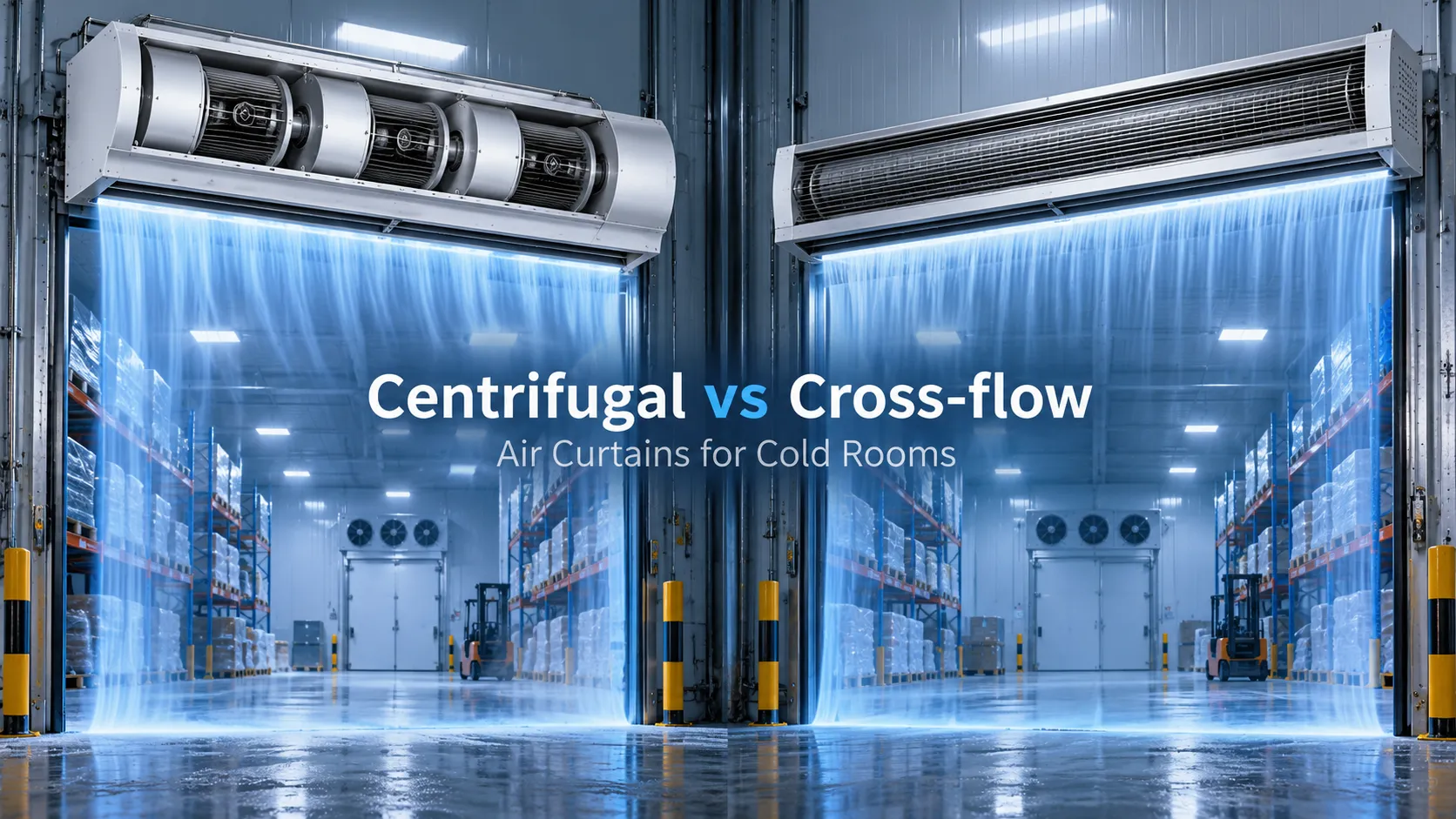
Height changes the required jet momentum. A standard pedestrian entrance may work well with a cross-flow model, while a taller opening may require a centrifugal design with higher pressure and stronger projection.
HUANGXI Q-Series models are published in common lengths from 60 to 200 cm with air speed around 8–11 m/s. The LY centrifugal series is published around 14–18 m/s, providing a stronger option for taller or more exposed commercial doors.
For standard entrances, review the Q Series Air Curtain. For stronger projection, compare the centrifugal LY range.
| Type | Strength | Typical Applications |
| Cross-flow | Compact, broad and even airflow | Retail, cafés, pharmacies, offices |
| Centrifugal | Higher pressure and stronger projection | Taller doors, exposed entrances, high traffic |
| Recessed | Concealed appearance with architectural integration | Hotels, malls, premium offices |
No type is universally superior. Cross-flow units are efficient and compact for many commercial doors. Centrifugal models are valuable when more projection is needed. Recessed designs solve an architectural problem by hiding most of the cabinet above the ceiling.
For concealed projects, see the HUANGXI Recessed Air Curtain.
Air speed is only one part of performance. Airflow is the volume of air delivered, while pressure capability and nozzle design influence how the jet holds together over distance. A high outlet speed does not guarantee good doorway separation if the air distribution is uneven or the discharge path is blocked.
A recognized test framework is ANSI/AMCA Standard 220-21. It provides laboratory methods for rating air curtain aerodynamic performance.
For buyers, the practical lesson is to compare complete performance data rather than a single headline speed number.
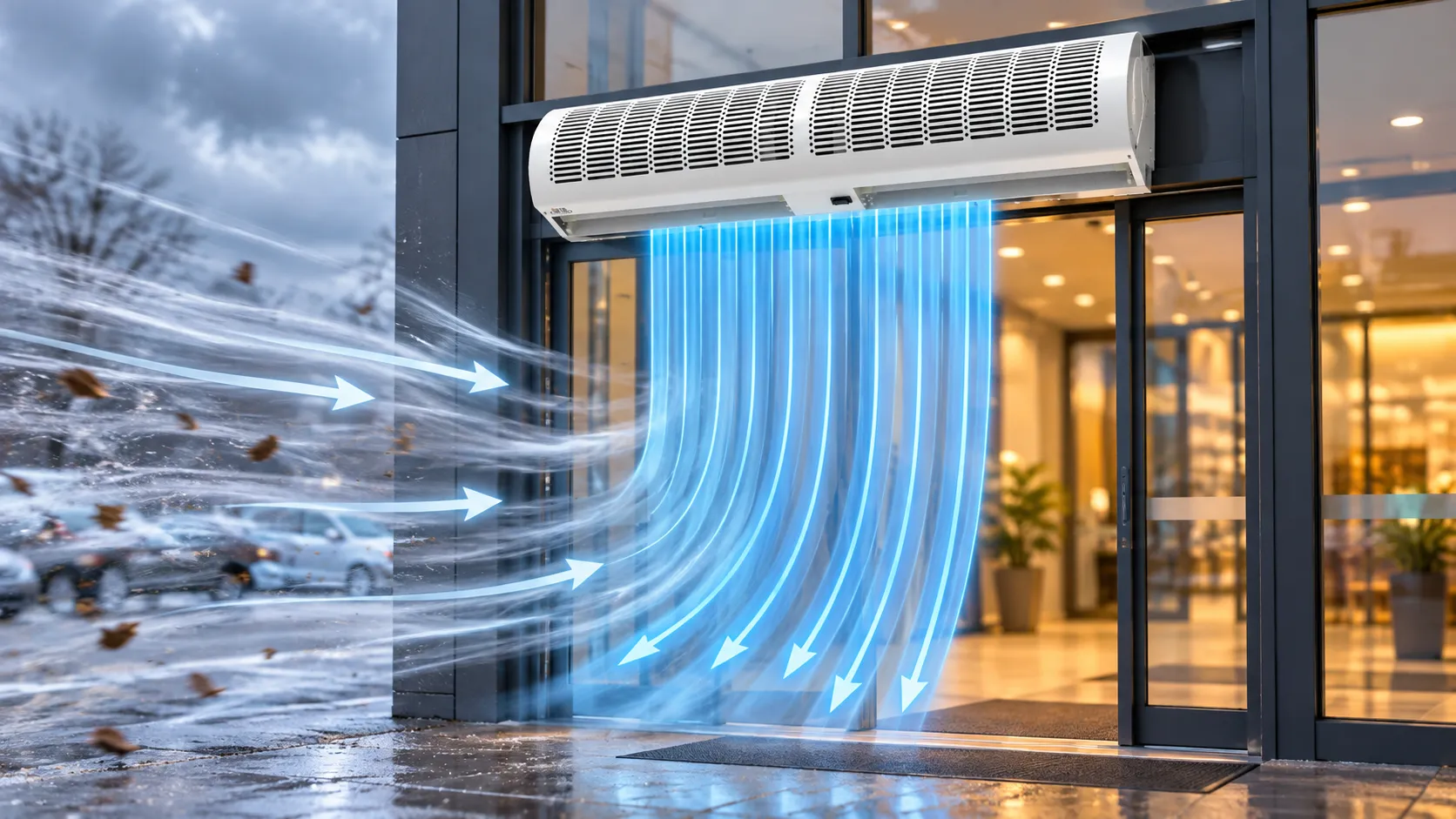
Kitchen exhaust, restroom exhaust, ventilation systems and stairwell pressure can make a building negative or positive relative to outdoors. When the building is negative, outdoor air is pulled inward and can bend the air curtain jet. Strong external wind can have the same effect.
For Mexico, Brazil and South America, regional selection should account for local climate, door exposure, voltage and frequency, architectural style and operating hours. Humid coastal areas, hot inland commercial districts and highly air-conditioned shopping centers can impose very different pressure and comfort conditions. A buyer should therefore send project-specific doorway dimensions and site information rather than selecting only from a catalog length.
Where pressure imbalance is severe, fixing the building air balance can be more effective than simply increasing air curtain speed.
Retail stores benefit from open, welcoming entrances and reduced drafts. Supermarkets need stable separation where customer traffic is continuous. Restaurants may value both thermal separation and reduced movement of insects or odors. Hotels and offices often place greater emphasis on noise and appearance.
Shopping malls and premium entrances may favor recessed designs, while exposed shopfronts may need centrifugal projection. Stainless housings can be useful where moisture, cleaning or corrosion resistance matters.
For demanding commercial conditions, review the Stainless Air Curtain Q.
Noise matters more in commercial spaces than in many industrial applications. The correct unit should provide sufficient barrier performance without creating an aggressive draft or excessive sound at customer level.
Lower fan speed may be appropriate during mild weather, while higher speed can be used when outdoor pressure increases. Multi-speed operation therefore helps match performance to real conditions rather than running at maximum continuously.
Automatic controls can reduce unnecessary runtime. A door-magnetic sensor can start the air curtain when the door opens and stop it when the door closes. An infrared presence sensor can detect approaching people and operate the unit around traffic events.
HUANGXI’s catalog shows both door-magnetic and infrared presence-control concepts. These options are especially useful for automatic doors or entrances that are closed for long periods between uses.
Optional filters can reduce dust and hair entering the fan section and help protect internal components. However, filters add resistance and must be cleaned. A neglected filter can weaken the jet and reduce separation performance.
Routine maintenance should include cleaning the intake, checking the filter where fitted, inspecting fan wheels and mounting hardware, confirming the discharge path is clear, and verifying control sensors. A gradual reduction in airflow can weaken the barrier even when the motor still appears to run normally, so visual and functional inspection should be part of the facility maintenance schedule.
For Mexico, Brazil and South America, regional selection should account for local climate, door exposure, voltage and frequency, architectural style and operating hours. Humid coastal areas, hot inland commercial districts and highly air-conditioned shopping centers can impose very different pressure and comfort conditions. A buyer should therefore send project-specific doorway dimensions and site information rather than selecting only from a catalog length.
HUANGXI commercial Q and centrifugal ranges list 110/220 V and 50/60 Hz options on many models. The exact voltage, frequency, control board and accessory configuration should still be confirmed for the destination project before production or shipment.
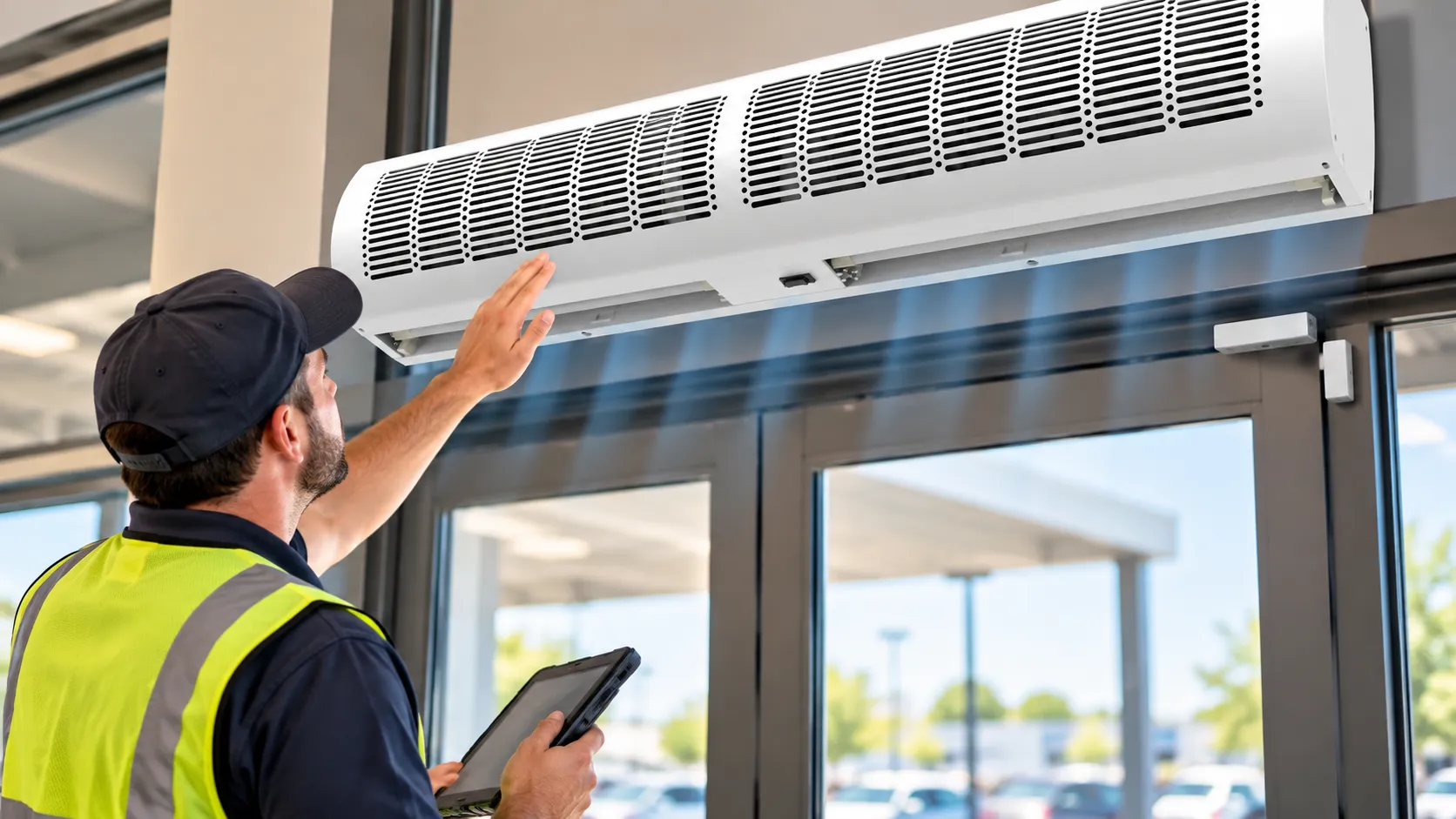
After mounting, test the unit with the door open and the building HVAC and exhaust systems operating. Observe whether the jet reaches the target zone and whether it bends noticeably inward or outward.
Adjust speed and discharge angle where available. Confirm sensor timing and check that the intake and outlet are not obstructed. A simple commissioning record provides a baseline for future service.
A commercial entrance is not an isolated opening. The air curtain jet interacts with the pressure field created by supply air, exhaust air, elevator shafts, stairwells, kitchen hoods, restroom exhaust and wind. If the building is under negative pressure, outside air is pulled toward the entrance. The air curtain must then oppose that inward crossflow, and a jet that looks strong in a showroom can bend significantly in the real building. Positive pressure can create the opposite effect and push conditioned air outward.
Door operation also changes the pressure pattern. Sliding automatic doors create a different opening geometry from hinged doors, revolving doors or double-door vestibules. The opening duration matters because a jet needs time to establish a stable flow field. On rapidly cycling automatic doors, sensor timing should start the air curtain early enough that useful momentum is present when the opening is exposed.
For projects in coastal or storm-prone areas, wind should be considered as a design variable rather than an occasional disturbance. A protected mall entrance and a street-facing entrance can have the same width and height but require very different air curtain performance. The most reliable selection process combines manufacturer data with site observations, drawings and, for difficult projects, an airflow review by the HVAC engineer.
Air curtain data sheets commonly list voltage, frequency, power, air speed, airflow, noise, weight and cabinet size. Each item answers a different question. Air speed indicates the local velocity near the outlet. Airflow indicates how much air volume is moved through the unit. Power indicates electrical input, not separation efficiency. Noise is influenced by test distance, speed setting and installation environment. Cabinet size determines whether the unit fits the architectural space, but does not by itself indicate the maximum effective door height.
When comparing two models, first confirm that the measurement conditions are comparable. A single maximum air-speed number can be misleading if one manufacturer measures at the nozzle while another reports a value at a different location. Airflow should be considered together with outlet geometry because a narrow high-speed jet and a wider lower-speed jet can behave differently. The project objective is not to maximize any one number; it is to maintain a stable air barrier across the opening.
For specification-driven projects, recognized aerodynamic test methods such as ANSI/AMCA Standard 220 provide a useful reference framework. Even when the project does not require a certified rating, asking how airflow and velocity were measured encourages more consistent technical comparison and reduces the risk of buying only on marketing claims.
The relationship between the nozzle and the doorway plane deserves careful attention. If the unit is set too far inside the building, outside air can enter before the jet intercepts it. If it is set too far outside, conditioned indoor air may be captured by the stream and discharged outward. The practical target is usually to align the air curtain closely with the opening so that the jet forms a controlled boundary where the pressure-driven exchange would otherwise occur.
Discharge angle can be equally important. A perfectly vertical jet is not always optimal because wind or building pressure may push the stream to one side. Some installations benefit from a slight angle toward the higher-pressure side so the jet arrives near the desired floor position. The correct angle should be verified during commissioning rather than assumed from appearance.
Architectural elements can change the effective jet path. A deep door header, decorative sign, lighting track or automatic-door mechanism may split the airflow. During design review, draw a simple line from the discharge slot to the target zone and confirm that nothing blocks it. This low-cost check prevents many field problems.
Consider a street-facing retail store in a warm, humid city. The entrance is 1.5 m wide, the door opens frequently, and the building uses air conditioning throughout business hours. The outdoor air carries both heat and moisture, while restroom exhaust creates a slight negative pressure inside. The customer wants an open, welcoming entrance without a heavy draft.
The selection process would begin with the clear opening width and installation height. If the door is within the effective range of a cross-flow unit and the entrance is sheltered, a Q-Series platform may provide sufficient coverage. If the entrance is taller or strongly exposed to wind, a centrifugal model may be more appropriate. The final decision should also consider noise, customer comfort and available mounting space.
After installation, the team should operate the building exhaust and air-conditioning systems, open the door, and observe the jet. If the stream bends sharply inward, the pressure imbalance may need correction. If the barrier is stable at medium speed, operating continuously at maximum speed may be unnecessary. This example shows why model selection, controls and commissioning should be treated as one process.
Providing these details with the inquiry allows the manufacturer to recommend a model based on the actual opening rather than guessing from a single dimension. It also creates a written project record that can be checked again during installation and commissioning.
Commercial air curtain design is successful only when environmental separation and customer experience work together. A unit may have impressive outlet velocity but still be unsuitable if the resulting draft is uncomfortable at head level or the sound level conflicts with a quiet hotel lobby, pharmacy or office reception. The operating speed should therefore be selected to achieve the required barrier with the lowest practical disturbance to occupants.
The physical location of the doorway also matters. A street-facing entrance exposed to buses, traffic and exterior noise may tolerate a different acoustic profile from an indoor mall entrance. In restaurants, the sound of the air curtain should be considered together with kitchen exhaust, background music and dining-area expectations. In premium retail, cabinet appearance, grille alignment and visible wiring can influence customer perception even when the airflow performance is correct.
Multi-speed operation is useful because the most demanding condition does not occur every hour. A higher setting can be used during hot afternoons, strong wind or peak traffic, while a lower setting may be adequate during mild periods. This approach can improve comfort and reduce unnecessary power consumption. The commissioning team should therefore document the preferred speed for typical operation and the conditions that justify moving to a higher setting.
Some entrances cannot be solved by the air curtain alone. A strongly negative restaurant, a loading area exposed directly to seasonal wind, or a large lobby with complex pressure paths may need additional building measures. These can include make-up air, vestibule improvements, door-control changes, sealing around the frame or changes to exhaust balance.
The air curtain should be viewed as one layer in the entrance strategy. A physical door still provides security and weather sealing when closed. A vestibule can reduce direct outdoor exposure. The air curtain supports the periods when the opening is active and people need unobstructed movement. When these elements are coordinated, each component can operate closer to its intended range.
This system-level view is especially important for retrofit projects. If a store has experienced years of severe drafts, simply replacing an old air curtain with a more powerful model may not address the root cause. A short site investigation of door use, exhaust systems, ceiling diffusers and pressure conditions can reveal whether the new air curtain should be accompanied by other corrections.
A technically useful quotation should contain more than model name and price. Ask the supplier to confirm cabinet length, voltage, frequency, power input, air speed range, airflow, control method, accessories, installation orientation, recommended application and available documentation. Where the project is sensitive to noise or height, ask for model-specific guidance rather than relying on family-level marketing language.
Also ask what is included in the carton: remote control, mounting hardware, sensor, filter or other accessories. Confirm whether optional parts require separate wiring or installation. If several identical entrances are being equipped across a chain, request a consistent model schedule so installers and maintenance teams work with the same configuration.
For larger projects, keep the approved quotation, technical sheet and entrance schedule together. This becomes the procurement record used to verify delivered models and to prevent substitutions that may fit physically but behave differently. Good documentation is part of a reliable air curtain project, not an administrative extra.
Air curtain settings should reflect seasonal conditions rather than remain fixed all year. During the hottest or most humid months, stronger outdoor-to-indoor pressure and larger temperature differences may justify a higher fan setting. During mild weather, the same entrance may be adequately protected at a lower speed. In some buildings, the air curtain may be unnecessary during hours when the door remains closed and traffic is minimal.
Facility teams should define simple operating rules instead of relying on individual judgment. For example, the normal speed can be documented for routine business hours, with a higher setting used during peak weather or high wind. Door-linked controls can be enabled when the entrance is intermittent. This makes operation easier to repeat across shifts and reduces the risk that staff turn the unit off because the airflow feels too strong.
Seasonal review is also a good time to clean filters, inspect the fan section and verify sensors. If an entrance that performed well last year now feels weak, the cause may be maintenance, a changed exhaust system or a new obstruction rather than the air curtain model itself.
Retail chains, restaurant groups and facility operators with many sites can benefit from a standardized entrance specification. Instead of selecting a different product for every store, the organization can create a small approved family for common doorway categories. One model group might cover standard entrances, another taller exposed entrances, and a recessed option can be reserved for premium architecture.
Standardization simplifies purchasing, installation training and spare-parts support. It also makes performance problems easier to diagnose because the maintenance team is familiar with the same controls and components across locations. However, standardization should not override site physics. A location with unusual wind exposure, negative pressure or a much taller door still needs project review.
A useful chain-store schedule records doorway width, installation height, selected model, speed setting, sensor type and commissioning notes. Over time, this database can reveal which configurations perform best and where application rules should be adjusted.
The best commercial air curtain is the one that creates a stable, continuous barrier across the actual doorway under real operating conditions. Width, height, airflow, velocity, pressure, noise, controls and building balance all matter.
For model selection and a project quotation, visit HUANGXI and send door width, installation height, photos or drawings, voltage/frequency and the intended application.
How do I size a commercial air curtain?
Match or slightly overlap the doorway width, then choose a model with sufficient projection for the installation height and pressure conditions.
Is centrifugal always better than cross-flow?
No. Centrifugal models usually provide stronger projection, while cross-flow models are compact and well suited to many standard commercial entrances.
Can an air curtain replace a physical door?
No. It reduces air exchange while the opening is in use but does not provide security or weather sealing like a closed door.
Can I connect the unit to the door?
Yes, where supported, door-magnetic or presence-sensor controls can automate operation.
What project information should I send?
Door width, height, site photos, application, voltage/frequency, traffic level and any special material or control requirements.