Horizontal vs Vertical Industrial Air Curtains for Large Doors
Horizontal vs Vertical Industrial Air Curtains for Large Doors Most air curtains are mounted horizontally…

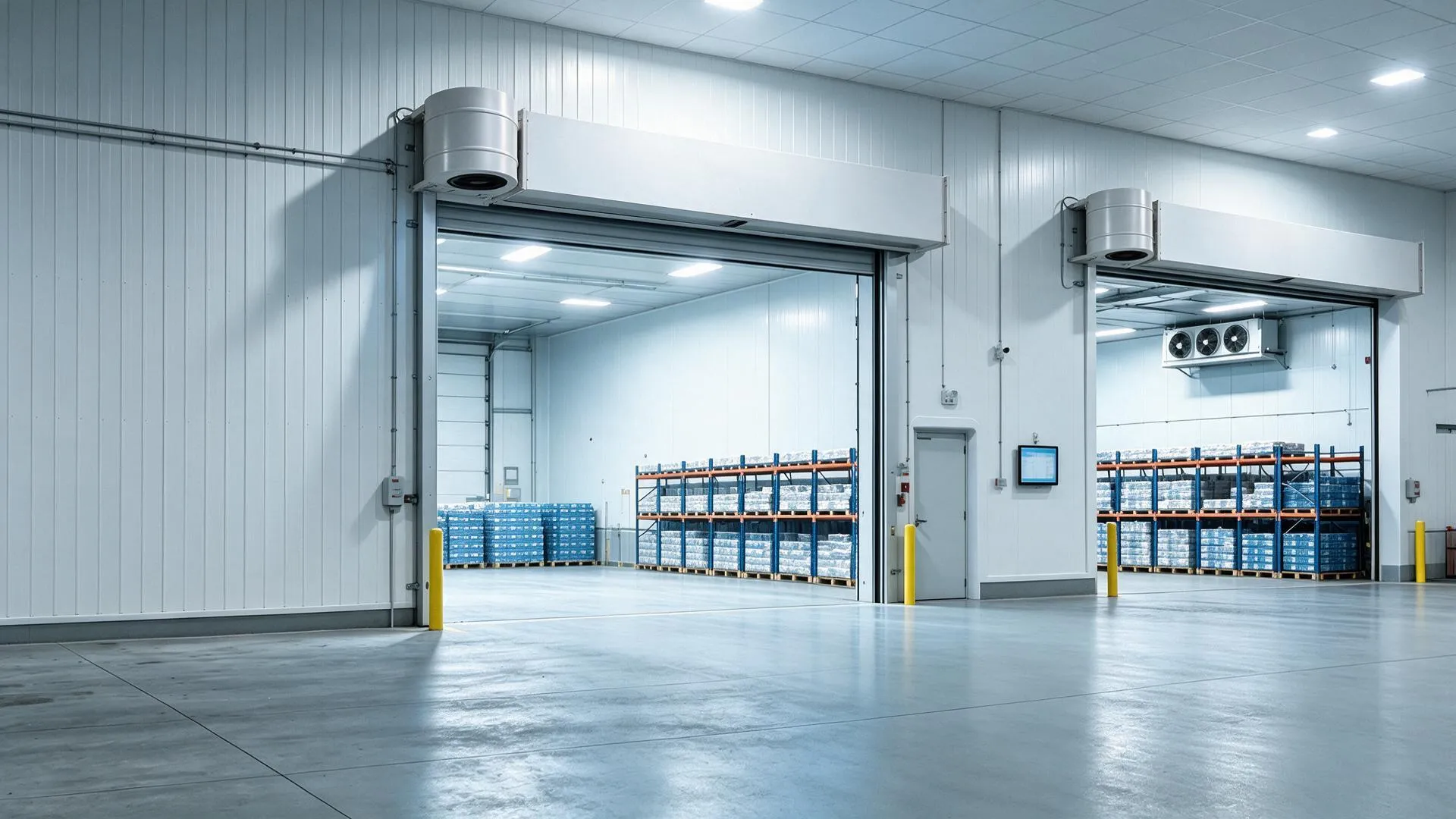
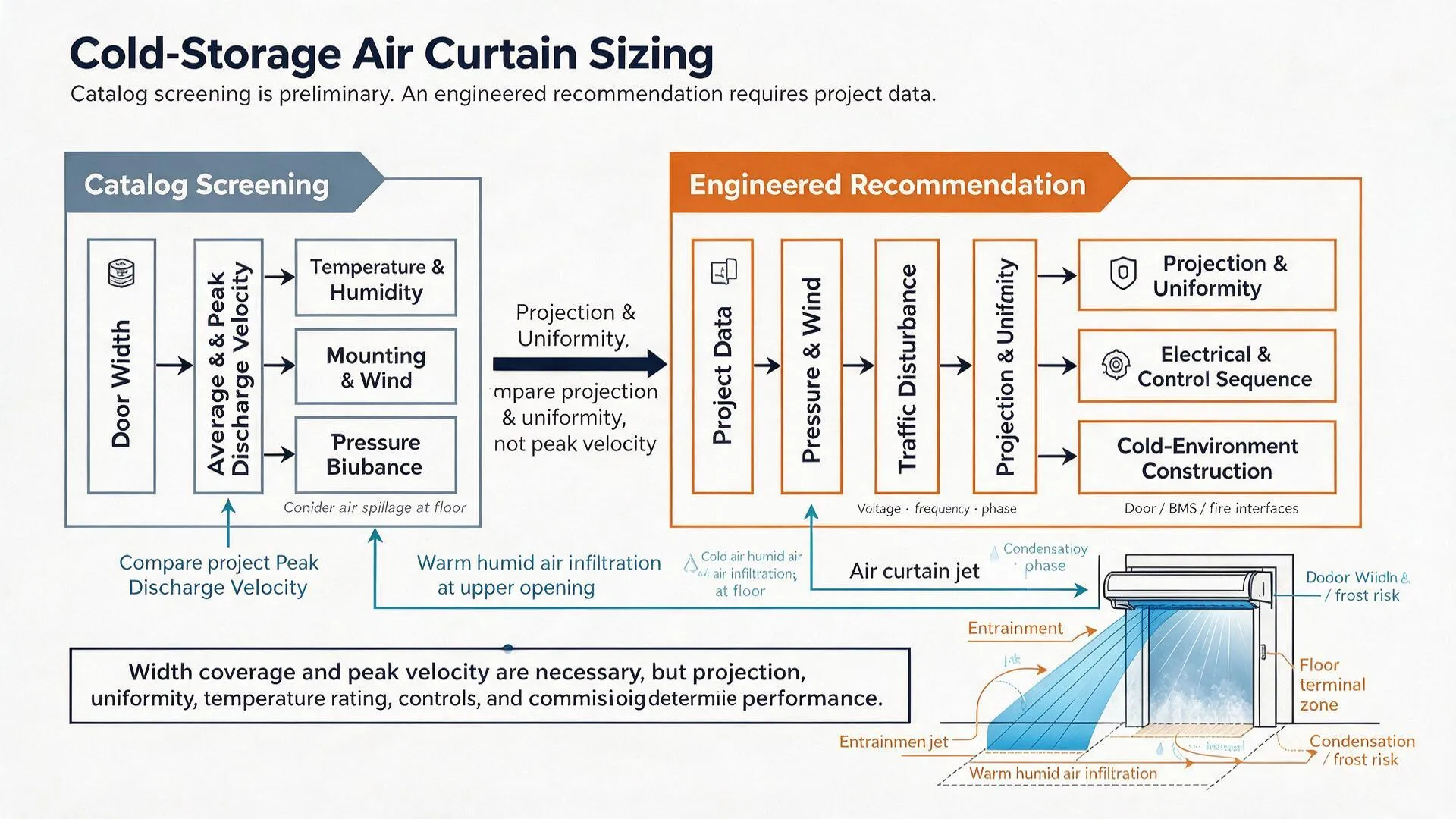
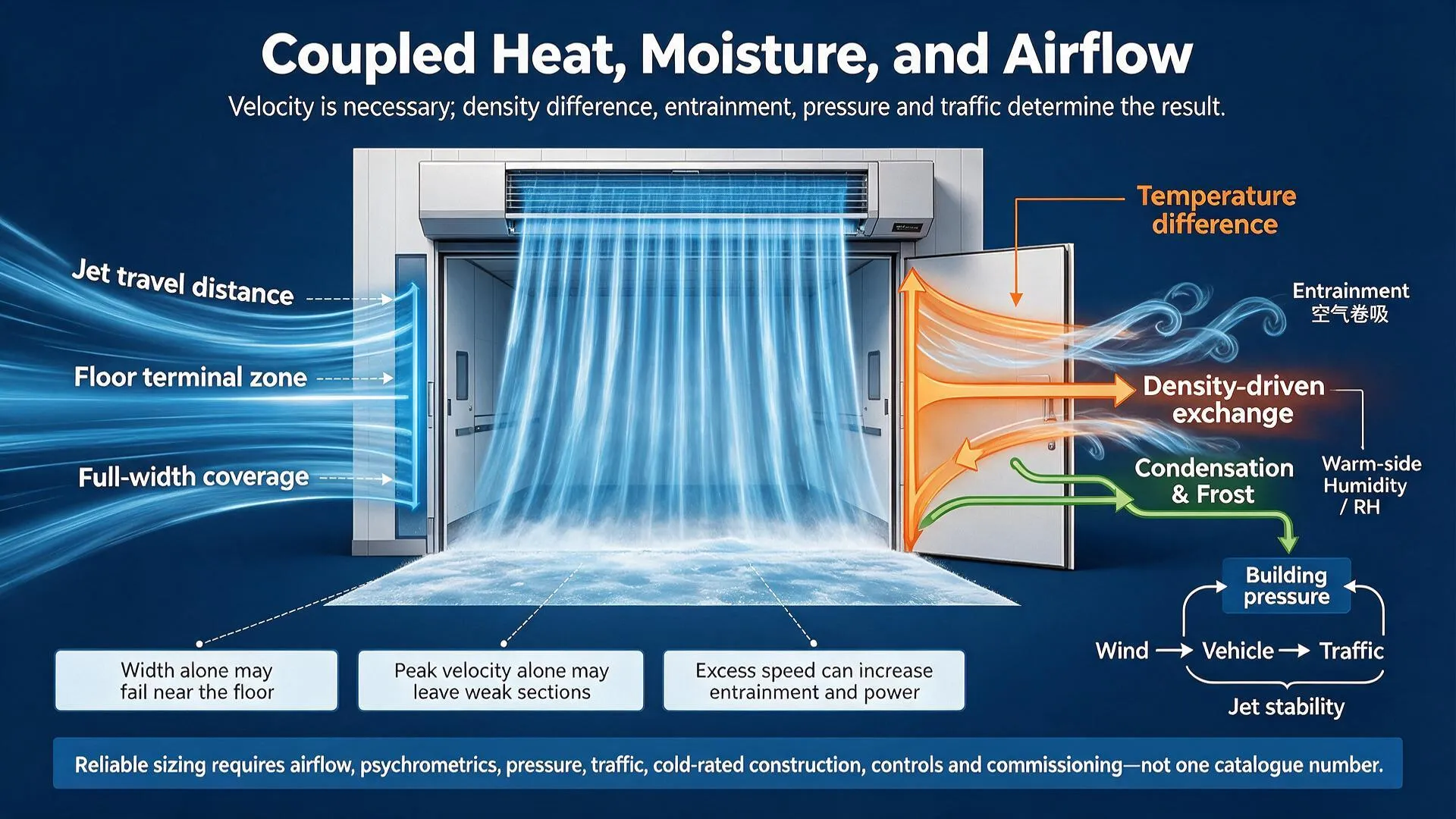
Reliable cold storage air curtain sizing has to solve a coupled heat-, moisture- and airflow problem. Door width determines how much of the opening must be covered. Mounting height determines the jet travel distance. Temperature and humidity determine the density difference and refrigeration penalty of infiltration. Pressure, wind and traffic determine whether the jet remains in the opening long enough to be useful.
A model chosen from width alone may blow air across the header yet fail to control exchange near the floor. A model chosen from maximum outlet velocity alone may create a strong local stream but leave weak sections across the door. The selection process below distinguishes catalogue screening from the project data needed for an engineered recommendation.
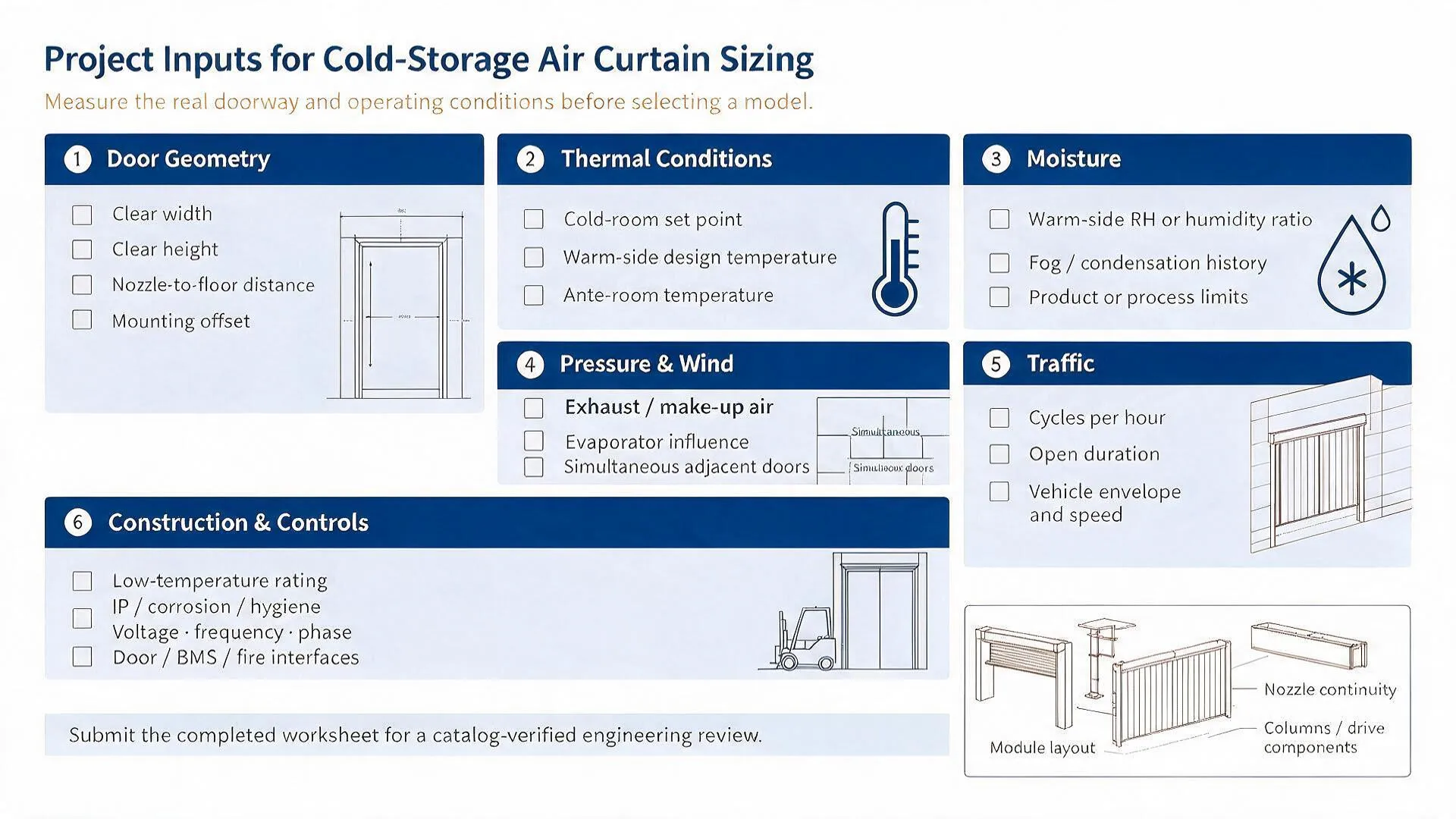
Record the unobstructed width and height of the door. Then measure from the proposed nozzle position to the floor. The second value can be greater than the door height because of the header, high-speed-door roll, structural beam or service clearance.
The combined discharge should cover the full clear width without gaps. If several modules are required, the layout should show nozzle continuity, bracket positions and any separation caused by columns or drive components.
Do not move the unit far inside the room merely to clear door hardware. Offset increases the path before the jet reaches the opening plane and can allow warm air to bypass the barrier. Ask the manufacturer to approve the exact section drawing.
Use design conditions, not a single spot reading. Provide:
Temperature difference drives density-related exchange. Warm-side humidity determines how much water vapor accompanies the incoming air. When that air cools below its dew point, water condenses; below freezing, moisture can become frost or ice. This latent load can be operationally more damaging than a short temperature fluctuation because it affects floors, doors and evaporators.
AMCA’s article on cold-storage air-curtain applications emphasizes both velocity and entrainment and explains how humidity infiltration contributes to ice buildup and defrost demand.
Record exhaust fans, make-up air, evaporator airflow, adjacent doors and outdoor exposure. Test or model representative combinations. A cold-store doorway that opens into a conditioned ante-room behaves differently from one that faces a windy loading yard.
The air curtain should not be expected to correct a large building make-up-air deficit. If exhaust equipment pulls substantial air through the doorway, the pressure problem should be addressed as part of the ventilation design.
ASHRAE’s air-curtain design discussion includes pressure difference, supply density, discharge-area ratio and dynamic efficiency. The implication for selection is that identical door dimensions do not guarantee identical air-curtain duty.
Provide openings per hour, average and maximum open duration, shift schedule and the largest passing vehicle/load. Include typical approach direction and speed. A forklift carries air across the barrier and leaves a wake; the jet then needs time to recover.
Experimental work on passage through an air curtain between spaces at different temperatures found that increasing passage speed increases transported fluid. This supports a practical rule: high-traffic sizing and controls should be checked under moving-load conditions rather than from a static doorway test.
Ask the supplier for the following data at the proposed speed:
The jet must have enough momentum to resist cross-opening forces and enough thickness/uniformity to avoid weak leakage paths. Higher velocity is not endlessly better; excessive speed or poor angle can increase entrainment and power consumption.
ANSI/AMCA Standard 220-21 is the relevant laboratory method for aerodynamic rating. A tested projection value is more useful than an unqualified “high speed” label.
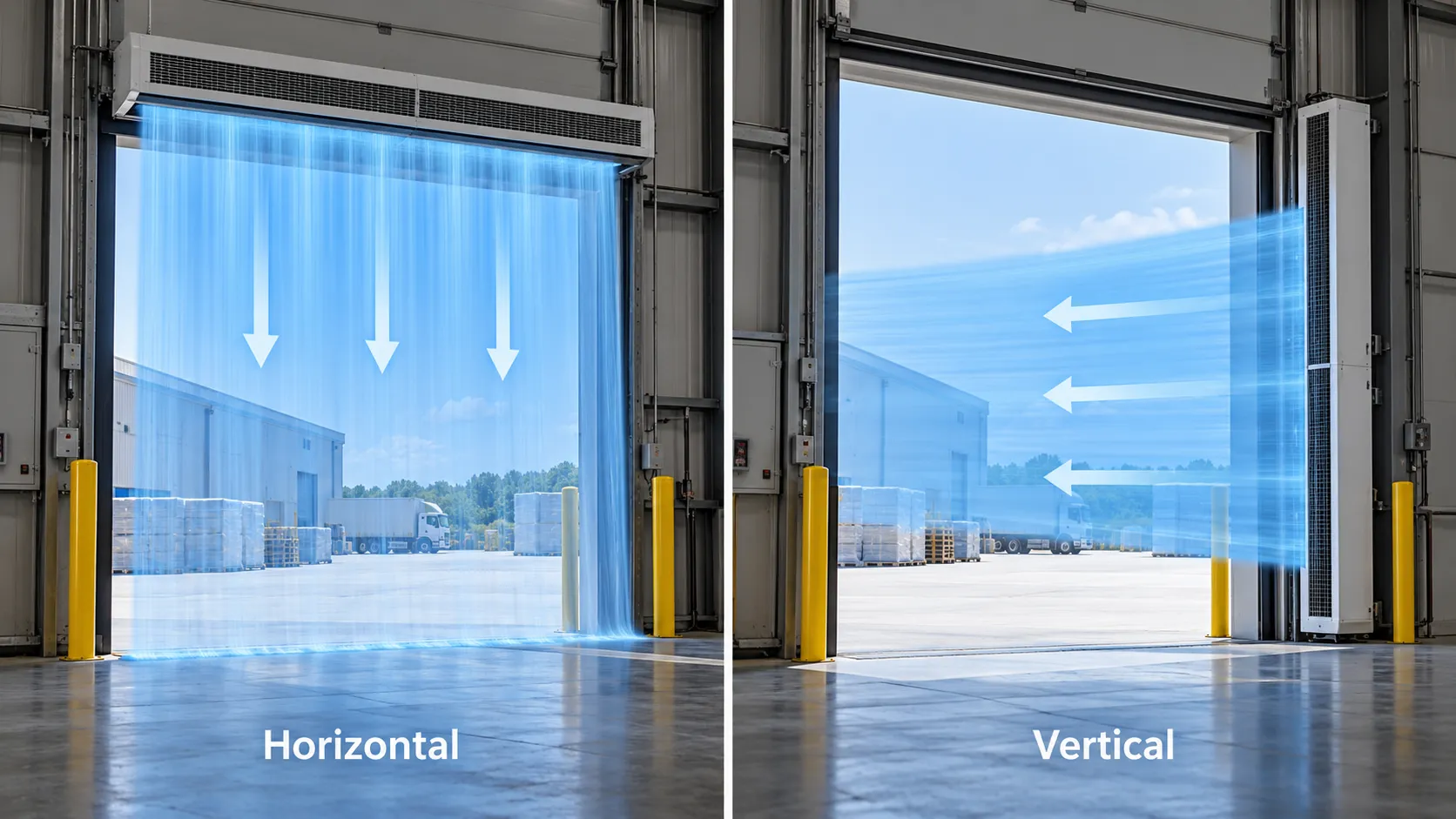
Horizontal mounting above the door is usually the first layout because it keeps equipment away from vehicle impact and uses the floor as a terminal surface. Consider vertical mounting when the header is blocked, the opening is very tall relative to its width, or a side layout provides a shorter verified jet distance.
For a two-sided vertical system, the opposing jets and meeting zone must be engineered. They should not be assumed to form a stable barrier simply because both fans use the same speed.
Large industrial doors may require a modular bank or a custom structure. Cross-check the application with HUANGXI’s industrial air curtain category and vertical air curtain category.
Ask for the permitted ambient and airstream temperature range, motor and bearing limits, lubricant suitability, condensation protection, casing material, fasteners, ingress protection, insulation and cleaning method. A room operating below freezing can create condensation on components outside the insulated envelope, while washdown or food processing adds separate material requirements.
Do not assume that a commercial centrifugal air curtain becomes a freezer model because it has a metal casing or high velocity. The manufacturer must approve the complete assembly for the stated temperature and humidity.
State line voltage, frequency, phase, control voltage, starting method and local conformity requirements. Mexico and Brazil use 60 Hz systems, so a 50 Hz catalogue motor must not be treated as automatically compatible. Obtain written confirmation for the exact motor/impeller/control combination.
Define how the air curtain interacts with:
| Category | Project input |
|---|---|
| Door geometry | Clear width; clear height; proposed nozzle-to-floor distance; mounting offset |
| Thermal | Cold-side set point; warm-side design temperature; ante-room temperature |
| Moisture | Warm-side RH/humidity ratio; visible fog/condensation history; washdown |
| Pressure | Exhaust/make-up air; evaporator influence; outdoor wind; simultaneous doors |
| Traffic | Cycles/hour; open seconds/cycle; vehicle/load envelope and speed |
| Construction | Material, corrosion, hygiene, low-temperature and ingress requirements |
| Electrical/control | Voltage; frequency; phase; door/BMS/fire interfaces; speed logic |
| Acceptance | Coverage, measured jet path, recovery, condensation and operating trend checks |
For screening, the catalog lists single-motor LFM250/LFM280 units at 380 V, 50 Hz with approximately 1,650–3,680 m³/h and 16–19 m/s, dual-motor LFM250S/LFM280S units at approximately 4,120–7,200 m³/h and 19–23 m/s, and inner-rotor LFM260 units at approximately 1,510–5,580 m³/h and 14.5–17.5 m/s. Listed unit lengths run from about 1,200 to 3,920 mm; the catalog recommends roughly 2.0–3.0 m, 2.5–3.5 m or ≥3.5 m mounting bands depending on family.
The catalog does not publish a minimum operating temperature, IP rating or 60 Hz option. Treat these as selection checks for Mexico and Brazil, not assumptions.
Use the HUANGXI cold-storage air curtain page to identify the application family, then submit the worksheet for a catalog-verified model selection. If a centrifugal commercial platform is being considered, compare it with the HUANGXI LYB series but obtain explicit written approval for the cold-room temperature and electrical supply.
The existing HUANGXI article on cold-storage air-curtain energy provides a general business context. A project estimate should replace generic percentages with measured door-open time, local psychrometric data and refrigeration-system performance.
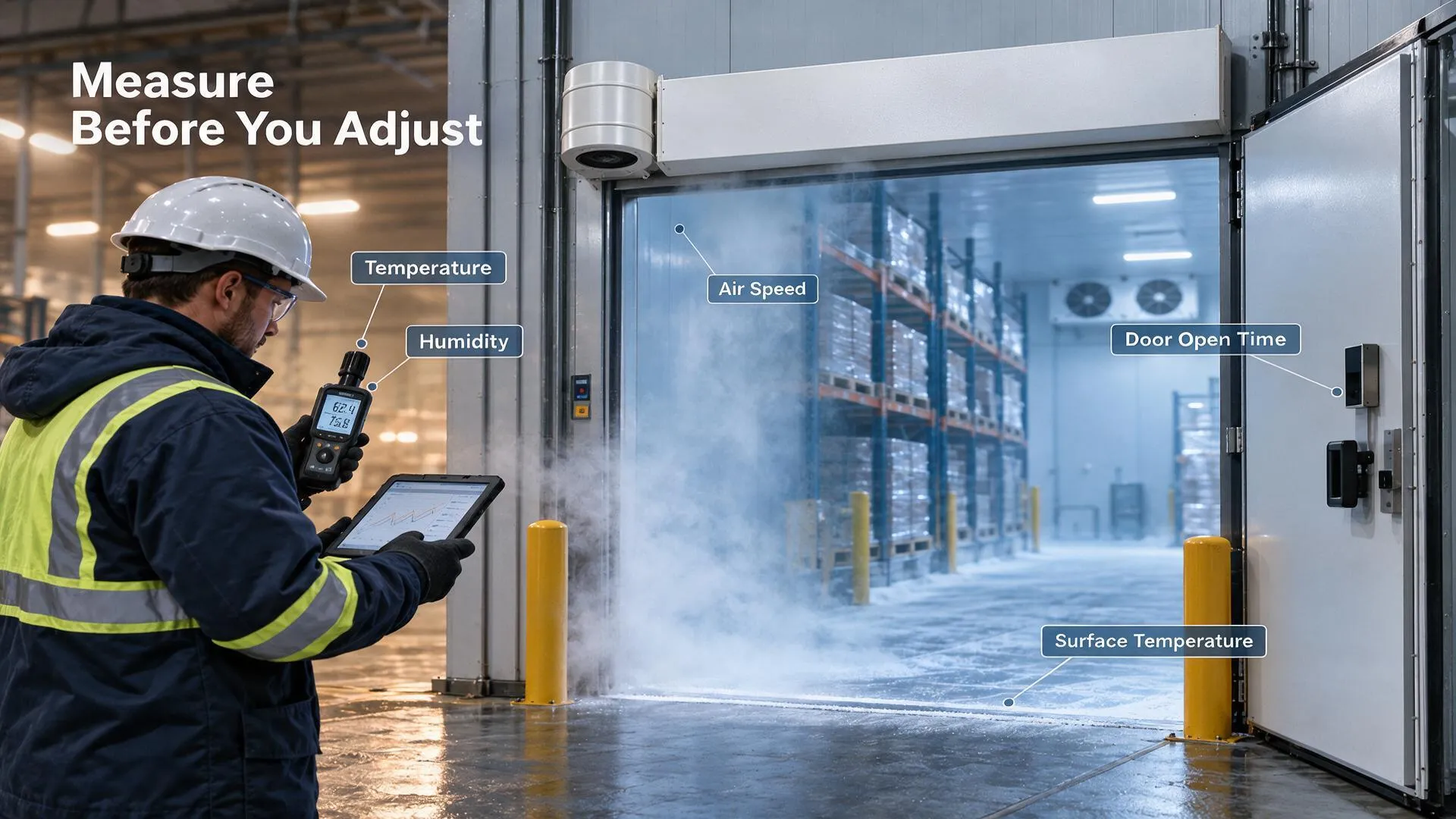
After installation, verify full-width coverage, jet direction and terminal behavior with the door open. Operate exhaust systems and adjacent doors in representative combinations. Pass the normal forklift/load through and confirm recovery. Trend temperature and humidity near the doorway and inspect for fog, wet surfaces and ice under comparable weather and traffic.
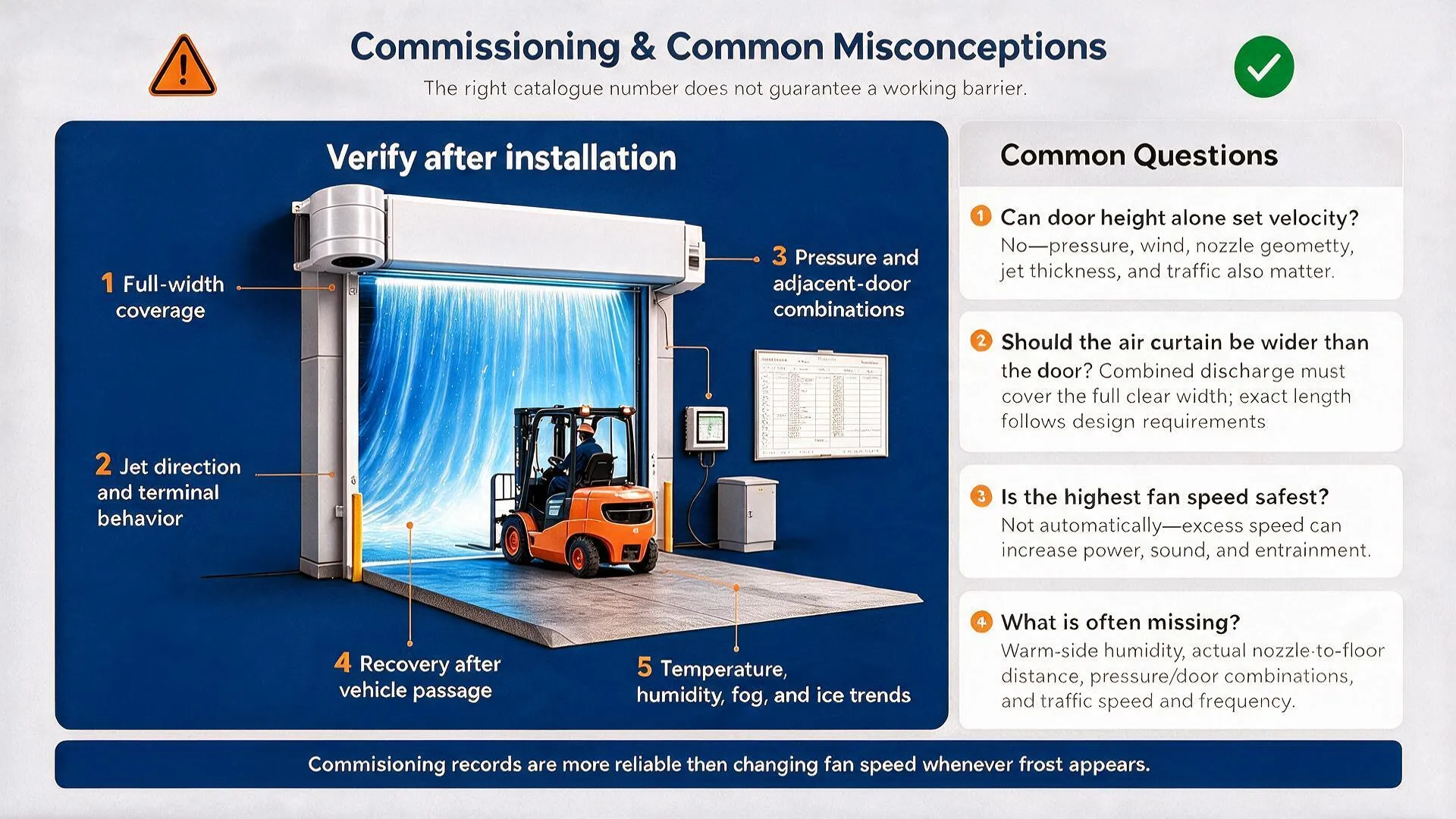
Record final speed and angle settings, motor current, control delays and maintenance access. A commissioning record makes later troubleshooting much more reliable than changing fan speed whenever frost appears.
Cold-storage air curtain sizing combines geometry, psychrometrics, pressure and traffic. Width coverage and outlet velocity are necessary, but projection, uniformity, temperature rating, controls and commissioning decide whether the air barrier works in practice.
Send HUANGXI the completed project inputs and dimensioned photos. The engineering review can then identify the appropriate centrifugal cold-storage series, module count, mounting layout and compatible 60 Hz electrical configuration for Mexico or Brazil.
No. Height sets the travel distance, but pressure difference, wind, nozzle geometry, jet thickness and traffic also affect the required duty. Use tested projection and project conditions.
The combined discharge must cover the full clear width without gaps. The exact length and any overlap should follow the manufacturer’s approved mounting drawing.
Not automatically. Excessive speed can increase power, sound and entrainment. The goal is a stable barrier at the design condition with a justified margin.
Warm-side humidity, actual nozzle-to-floor distance, building pressure/door combinations and traffic speed are commonly omitted, yet each can materially change performance.