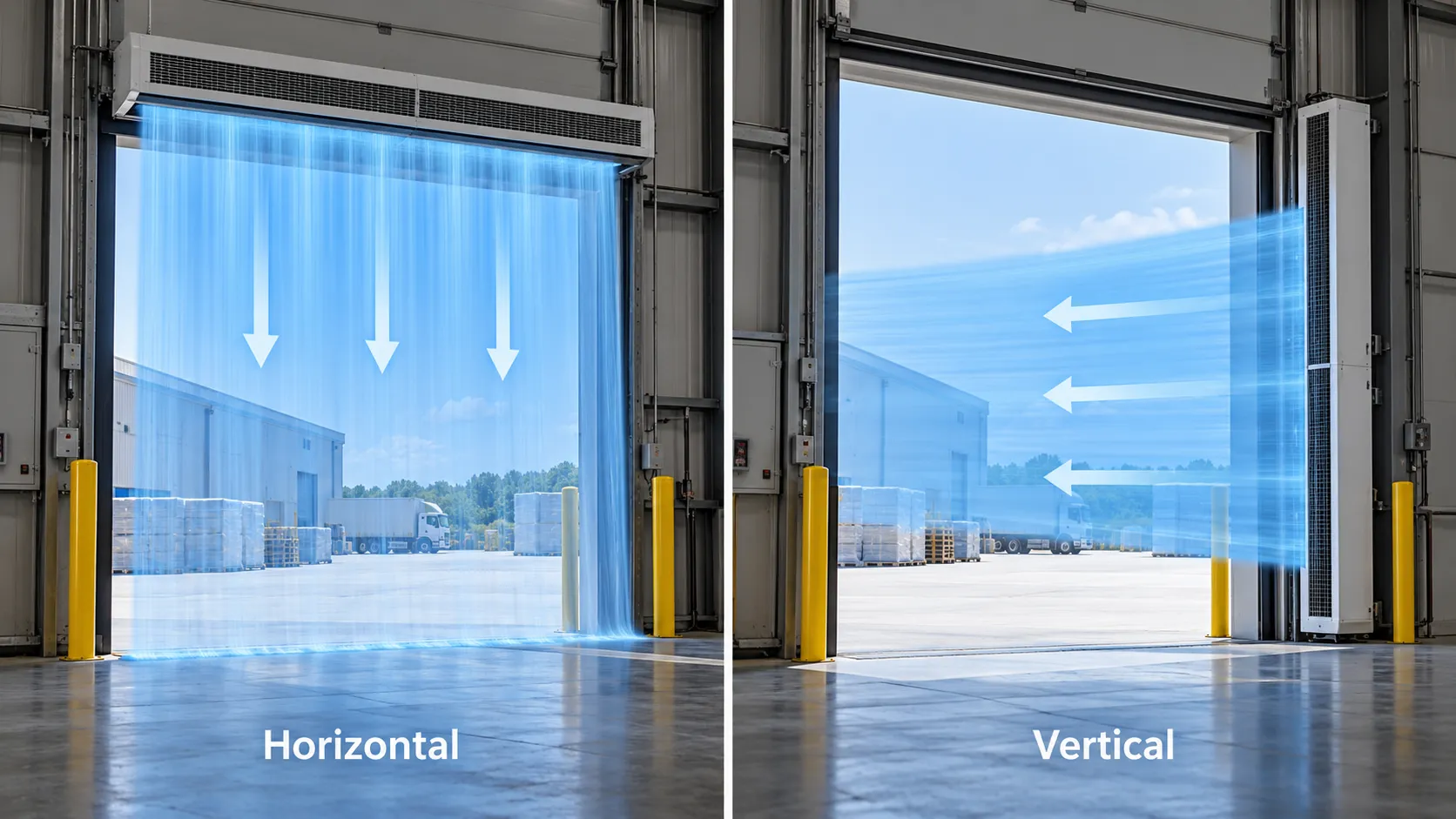
Horizontal vs Vertical Industrial Air Curtains for Large Doors
Horizontal vs Vertical Industrial Air Curtains for Large Doors Most air curtains are mounted horizontally…


Buyers comparing a centrifugal vs cross-flow air curtain often receive a simplified answer: centrifugal means pressure, while cross-flow means quiet and uniform airflow. That description can help explain the architectures, but it cannot select a cold-room product. Impeller type is only one part of the assembled air curtain, and the doorway needs verified jet projection, full-width uniformity, environmental suitability and compatible controls.
This guide explains where the two fan arrangements differ and how to compare them without turning a component label into a performance guarantee.
Air enters a centrifugal impeller generally along its axis and leaves radially. A casing or volute collects and directs the flow toward the discharge. Depending on blade and casing design, the arrangement can provide useful pressure capability and can feed a defined nozzle at high velocity.
In an air curtain, one or more centrifugal blowers may be distributed along the housing. The internal plenum and nozzle must turn those individual flows into a continuous sheet. Poor distribution can create strong sections near blowers and weak sections between them, so velocity uniformity must be measured rather than assumed.

A cross-flow fan uses a long cylindrical impeller. Air passes through the blade row, across the interior and out through the blade row again, producing a discharge along much of the fan length. This geometry can fit a slim housing and support a long, continuous outlet.
Cross-flow does not automatically mean low velocity, nor does centrifugal automatically mean industrial duty. Diameter, length, rotational speed, inlet/outlet geometry, motor and nozzle determine the operating curve.
AMCA’s fan terminology defines centrifugal and axial flow paths and recognizes that geometry and casing influence the pressure range. The U.S. Department of Energy’s fan-system sourcebook provides the broader selection principle: evaluate the fan at the required system operating point.
A centrifugal arrangement is often chosen when the air path, nozzle or accessories require more pressure capability. That can support a high-momentum jet, especially when the doorway is tall or exposed. However, static pressure inside the unit is not the performance objective at the door. The objective is a stable, correctly directed plane jet at the installed distance.
A cross-flow design can be appropriate where the opening and nozzle require moderate pressure and long discharge continuity. If its tested projection reaches the terminal point under the design forces, a higher-pressure architecture adds no automatic benefit.

Ask for the complete-unit fan curve or rated duty, not an isolated impeller number. Intake screens, filters, heaters, close mounting surfaces and field guards can add resistance and move the operating point.
Cold-store infiltration will exploit weak sections. A single maximum reading at the center of the nozzle cannot describe full-width performance. Request the velocity profile or uniformity rating across the discharge.

A long cross-flow impeller can naturally support a continuous outlet, but end effects and casing design still matter. A multi-blower centrifugal unit can also be highly uniform when the plenum and nozzle distribute flow correctly. Architecture suggests design tendencies; test data establishes the result.
ANSI/AMCA Standard 220-21 covers aerodynamic rating for air-curtain units, including data that let buyers compare assembled products under a consistent method.
Outlet velocity decays as the jet entrains surrounding air and spreads. Compare velocity or momentum at the nozzle-to-floor distance—not only at the outlet. A cold room with a large temperature difference can bend the jet; wind and building pressure add further transverse force.
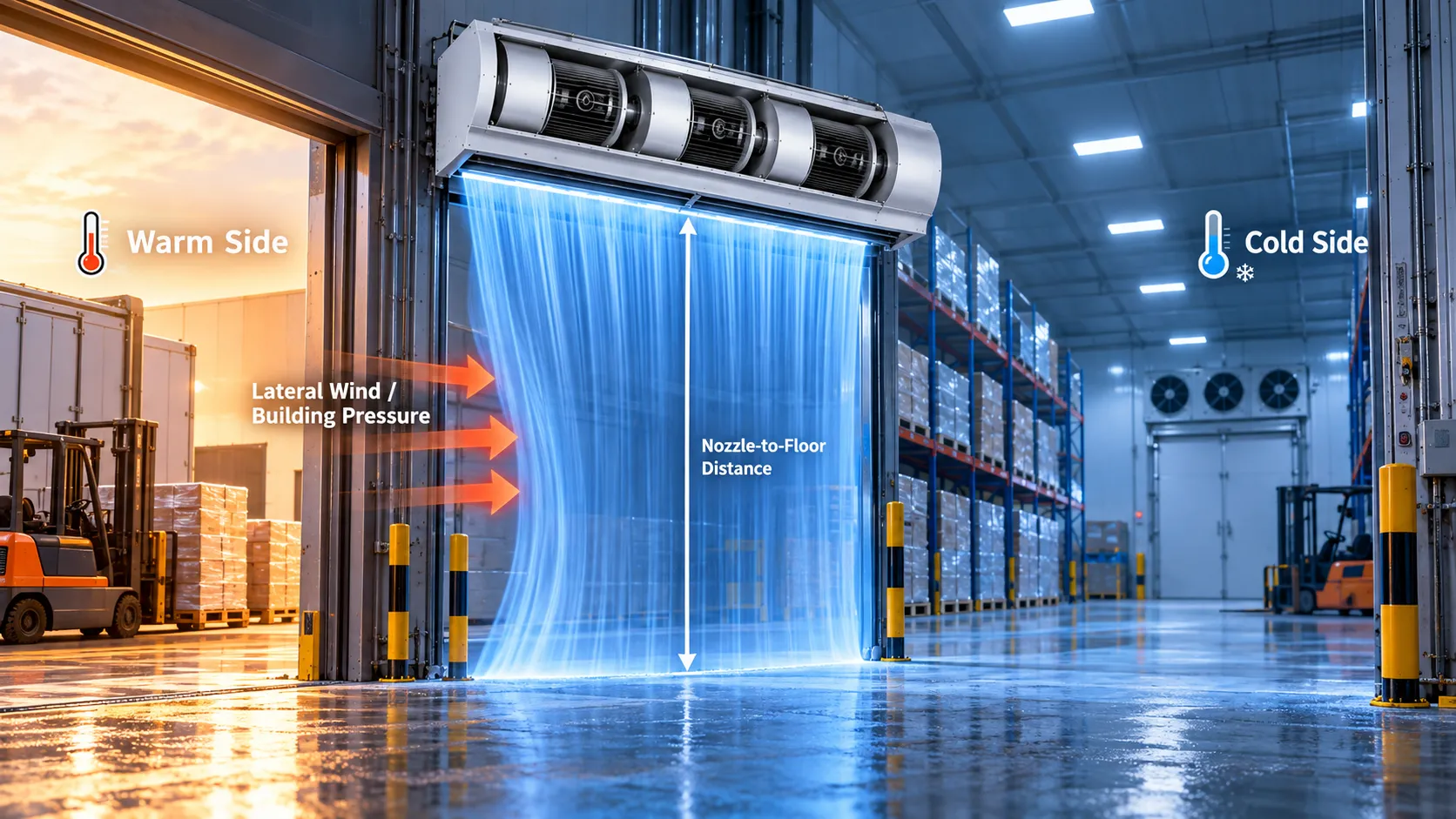
The proposal should state:
AMCA’s engineering article on cold-storage air curtains explains the balance among velocity, jet width, entrainment and terminal impact. A narrow high-speed jet can bend; a wider jet can entrain more air. The complete nozzle design seeks a stable operating balance.
A sound rating at low speed cannot be compared with another unit operating at the speed needed to reach the floor. Likewise, total watts are not meaningful unless both products deliver the required barrier duty.
Fan affinity relationships show why arbitrary speed increases can be expensive: for a geometrically similar fan in a comparable regime, airflow varies approximately with speed, pressure with speed squared and power with speed cubed. Real units require manufacturer data, but the relationship explains why commissioning should find the lowest stable duty rather than default to maximum speed.
Compare sound and electrical input at the selected operating point. Include motor efficiency, variable-speed losses and control run time in the operating-cost model.
A freezer environment affects bearings, lubricant, motor starting, cable flexibility, plastics and condensation. A fan architecture that performs well aerodynamically is still unsuitable if the complete unit is not approved for the minimum temperature and moisture conditions.
For each candidate, obtain written data for:
Do not classify a standard commercial centrifugal air curtain as a cold-storage unit from fan type alone. Do not assume a cross-flow unit is unsuitable merely because another architecture can create more pressure. Check the exact assembly.
A multi-blower centrifugal unit may allow individual sections to be serviced or can reveal a localized failure, but access and replacement depend on the product design. A long cross-flow impeller may offer fewer repeated blower modules, yet removal can require more lateral service space. Neither statement is universal.
Review:
| Criterion | Centrifugal tendency | Cross-flow tendency | Evidence required |
|---|---|---|---|
| Pressure capability | Often higher depending on impeller/casing | Often suited to lower/moderate resistance | Complete-unit curve or rated duty |
| Outlet packaging | Several blowers feeding plenum/nozzle | Long cylindrical impeller | Section drawing and nozzle profile |
| Uniformity | Depends on blower spacing and plenum | Depends on end effects and casing | Measured full-width velocity profile |
| Projection | Architecture is not proof | Velocity/momentum at installed distance | |
| Cold rating | Must be confirmed for the complete unit | Catalog/nameplate and manufacturer approval | |
| Service | Module access may be localized | Long rotor may need lateral access | Maintenance drawing and parts plan |
The catalog identifies centrifugal LFM families (LFM250/LFM280 single and dual motor, top-fan versions, inner-rotor LFM260 and explosion-proof LFM…B variants). It does not identify a cross-flow air-curtain series. The centrifugal tables list 380 V, 50 Hz input, approximately 1,510–7,200 m³/h across the shown families, 14.5–23 m/s catalog wind-speed values and unit lengths of about 1,200–3,920 mm.
The catalog does not publish a minimum operating temperature, IP rating or 60 Hz option. For Mexico and Brazil, confirm the exact electrical frequency, cold-room temperature, controls and mounting orientation in writing; do not infer cross-flow performance from centrifugal data.
The HUANGXI LYB series is a published centrifugal platform for commercial and industrial entrances. The separate cold-storage air curtain category addresses refrigerated applications. Use the new catalog to confirm which cold-storage series uses each fan architecture and which temperature/electrical conditions it supports.
If the opening is a large vehicle door, also review the industrial air curtain platform and the engineering principles in HUANGXI’s industrial selection guide. The final choice should connect product data to the cold-store doorway rather than mixing specifications from different families.
The cold-room opening defines the required coverage, projection and resistance to temperature, pressure and traffic. A centrifugal fan may be the better platform when pressure capability and high-momentum discharge are needed. A cross-flow fan may be effective when a long continuous outlet and compact housing meet the required projection. Test data and environmental approval decide—not the category name.

For a HUANGXI comparison, send the door dimensions, temperatures and humidity, traffic, pressure/wind conditions, mounting constraints and exact 60 Hz electrical supply. The response should identify the catalog series, fan architecture, measured duty and installation layout for the project.
No. Centrifugal designs often offer useful pressure capability, but actual airflow, velocity, projection and power depend on the complete fan, casing and nozzle.
No. Suitability depends on its tested duty and environmental rating. Do not infer mounting height or temperature capability from architecture alone.
Either can be well or poorly distributed. Compare the measured velocity profile across the full discharge at the operating speed.
The better unit is the one approved for the freezer temperature and moisture conditions that also provides verified full-width projection at the door. Fan type is one selection input, not the answer by itself.