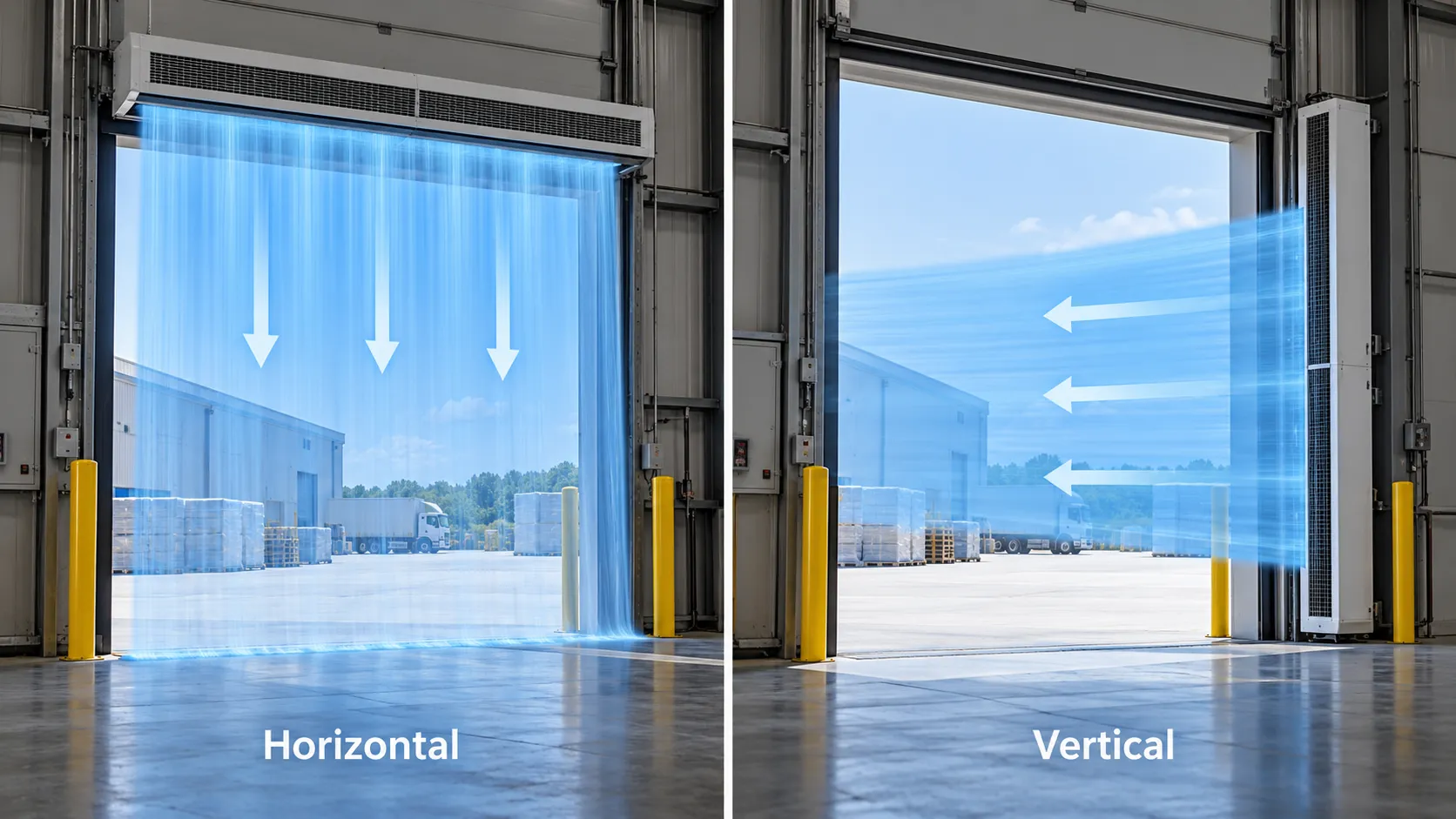
Horizontal vs Vertical Industrial Air Curtains for Large Doors
Horizontal vs Vertical Industrial Air Curtains for Large Doors Most air curtains are mounted horizontally…

Cold storage air curtain frost control begins with the moisture source. Fog at a freezer entrance, water on the warm-side floor and frost on the cold-side frame all indicate moisture movement, but they are not the same failure. Each symptom forms at a different combination of air temperature, humidity and surface temperature. An air curtain can reduce the warm-air infiltration that supplies this moisture, yet it should be configured as part of a door, pressure and humidity-control system—not sold as a cure for every patch of ice.
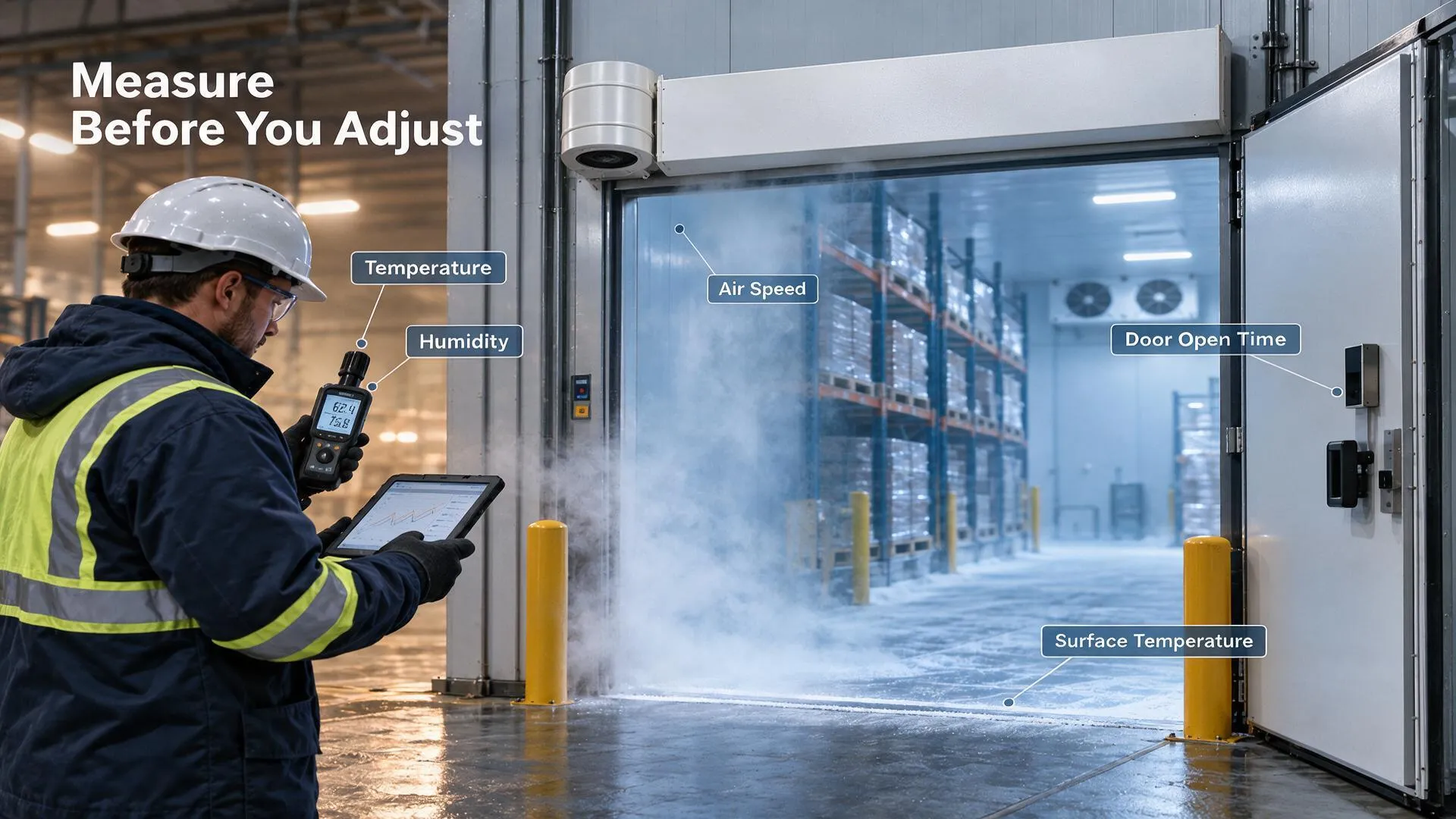
A useful troubleshooting process starts by identifying where water vapor enters, where it reaches dew point and where it freezes. That prevents technicians from increasing fan speed when the real cause is a damaged door seal, excessive negative pressure, a saturated ante-room or an incorrect defrost sequence.
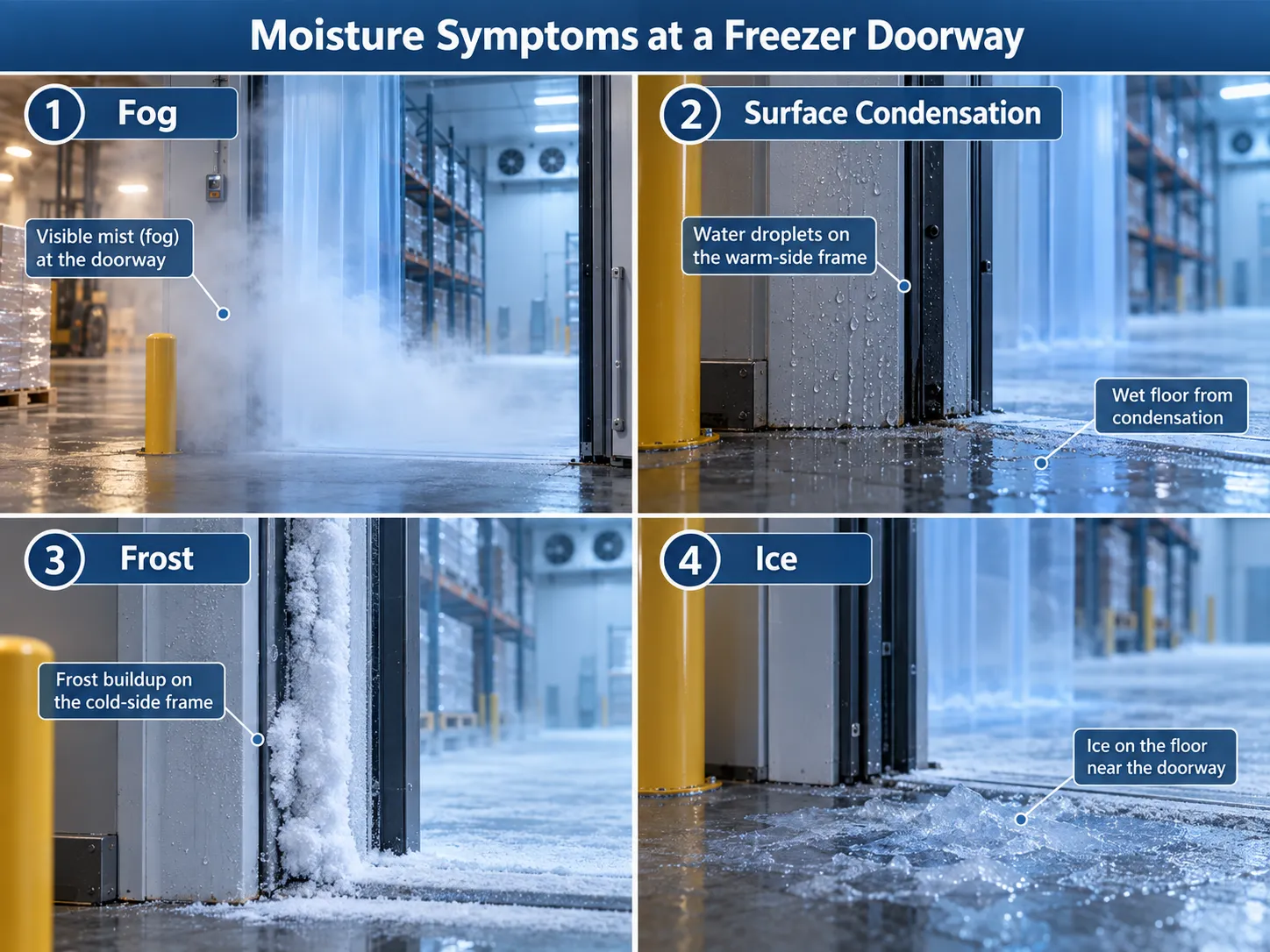
Fog consists of suspended liquid droplets or, in very cold conditions, a mixture that can include ice crystals. It becomes visible when warm humid air mixes rapidly with cold air and the mixture reaches saturation. At an open freezer door, fog often marks an active mixing region rather than a single leaking gasket.
Condensation forms when moist air contacts a surface below the air’s dew-point temperature. If the surface remains above freezing, the result is liquid water. Common locations include the warm-side door frame, floor, sensor housings and high-speed-door panels cooled by nearby freezer air.
Frost forms when water vapor deposits as ice or when condensed droplets freeze on a sufficiently cold surface. It can accumulate on frames, walls, product and evaporator coils. Frost is not only a housekeeping issue: on a heat exchanger it adds thermal resistance and restricts airflow.
Ice on the floor can form when condensed water, tracked water or defrost water reaches a subfreezing area. Its location may reveal the path of cold-air spillage or warm moist infiltration, but the source must be confirmed rather than assumed.
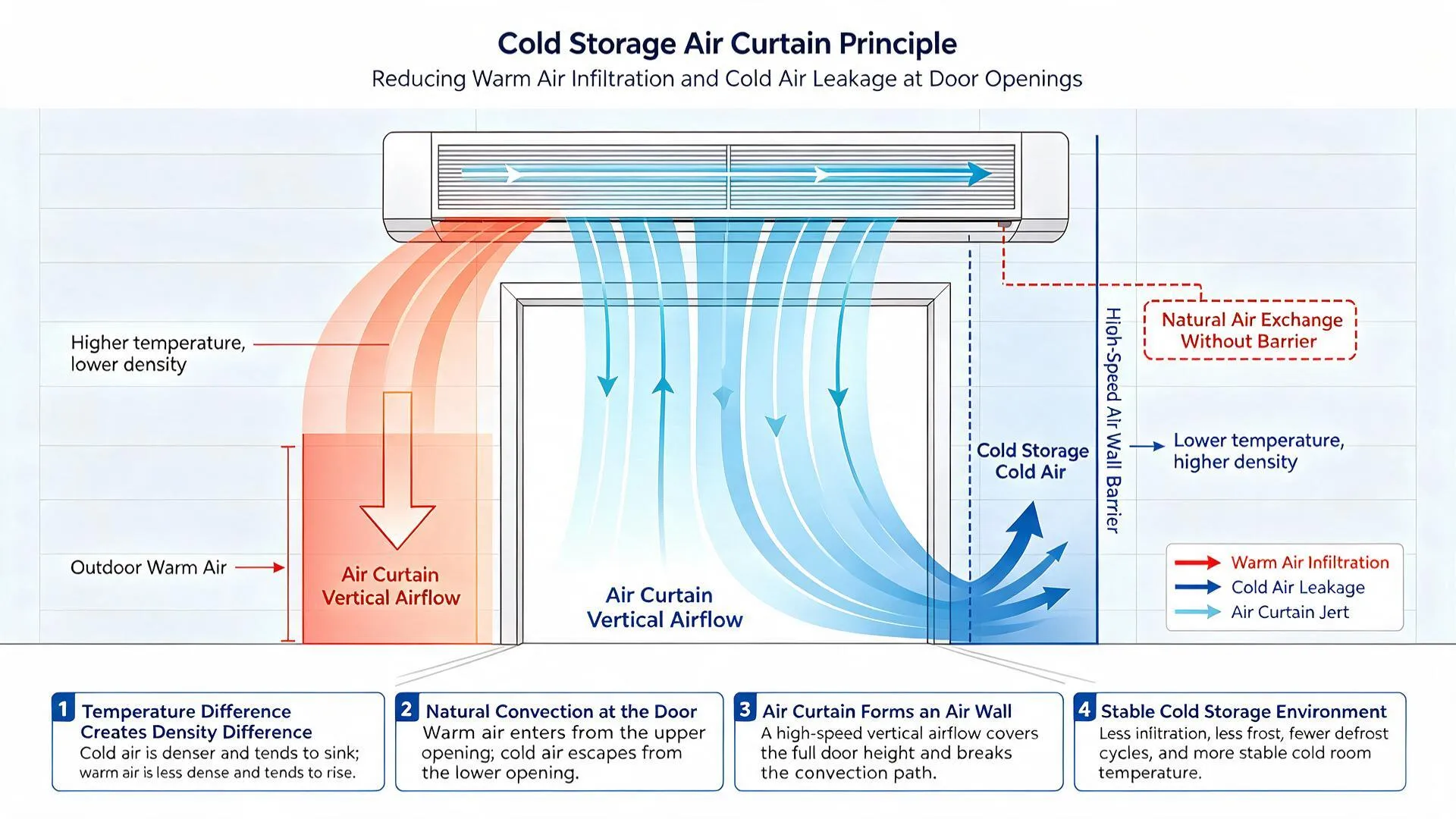
Cold air is denser than warm air. At a tall open doorway, cold air tends to leave low while warm air replaces it high. The incoming air carries water vapor. Cooling that air creates sensible refrigeration load; condensing and freezing its moisture creates latent load and frost.
A study of frost behavior on cold walls notes that warm humid infiltration through freezer access doors can create fog and ice crystals and can deposit frost on walls, products and evaporator coils. AMCA’s technical article on air curtains in cold-storage environments connects humidity infiltration with doorway ice and increased defrost cycling.
The risk is particularly important in warm, humid regions of Mexico and Brazil. Local buyers may describe the equipment as a cortina de aire para cámara frigorífica or cortina de ar para câmara fria; regardless of terminology, the design needs the actual warm-side temperature and humidity, not a generic regional climate label.
The air curtain projects a controlled sheet of air across the opening. When correctly sized and aimed, the jet reduces the two-way exchange and therefore the mass of water vapor entering the cold space. Less infiltration can mean less fog, reduced wetting of surfaces and less frost available to accumulate on the evaporator.
The barrier remains permeable and is disrupted by traffic. It must cover the full opening, retain useful momentum at the terminal point and operate at the right angle. A high outlet velocity with weak edges or insufficient projection can leave large moisture paths.
ANSI/AMCA Standard 220-21 provides methods for rating aerodynamic performance. Request tested airflow, discharge uniformity and projection rather than relying on a maximum-speed statement.
| Observed symptom | Possible causes to check | Air-curtain checks |
|---|---|---|
| Fog fills the opening | High warm-side humidity; long door-open time; pressure imbalance | Full-width jet, projection, angle and start timing |
| Water on warm-side floor | Cold-air spillage; cold bridge; door-panel cooling; drainage | Jet bending toward cold side; insufficient terminal control |
| Frost on cold-side frame | Humid leakage; gasket/door fault; surface temperature | Bypass at edges, header offset and weak nozzle zones |
| Evaporator frosts rapidly | Infiltration; product moisture; defrost/fan sequence; door discipline | Operating hours, interlock and jet recovery after traffic |
| Ice appears only after washdown | Water migration, cleaning schedule and drainage | Whether airflow moves liquid toward a cold surface |
| One edge remains wet | Local air leak, structural cold bridge or crosswind | Nozzle continuity, obstruction and module gap |
Exhaust equipment, insufficient make-up air or another open door can create negative pressure in the cold-store approach area. The air curtain then works against a continuous cross-opening flow. Measure or observe pressure with the plant in representative operating combinations.
An air curtain should not be used to conceal a ventilation imbalance. Correct make-up air or coordinate door operation where feasible, then tune the jet for the remaining design pressure.
A unit mounted high above the header or far inside the room allows bypass before the jet reaches the doorway plane. Door rolls and tracks often cause this installation compromise. The manufacturer should review a section drawing and verify the offset and projection.
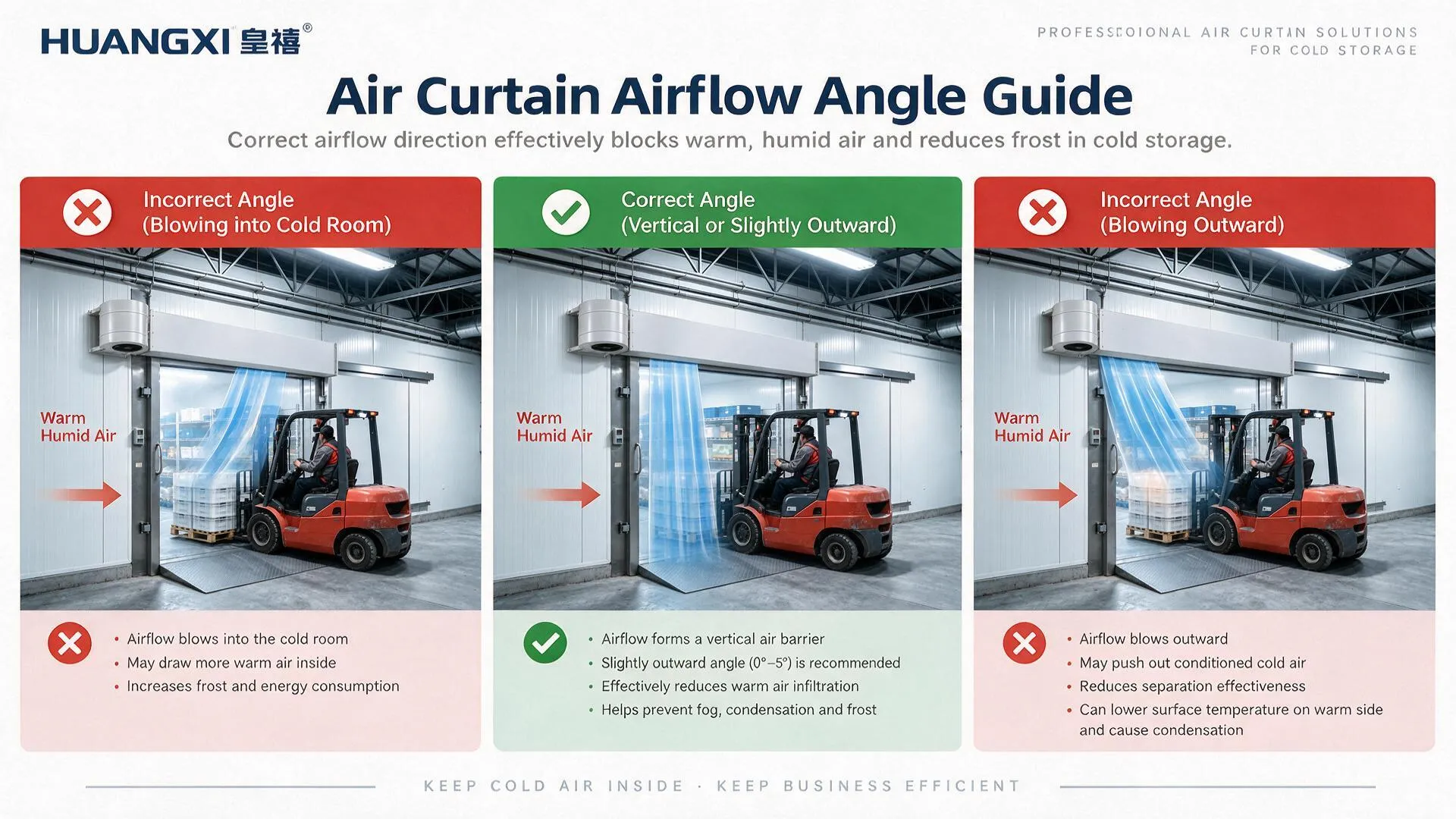
A jet directed too far into the freezer can entrain warm air toward the cold side. A jet aimed too far outward can eject conditioned air and chill warm-side surfaces. Adjust angle and speed together while monitoring the actual fog region, terminal behavior and surface conditions.
Aerodynamic sealing research at a refrigerated chamber found that performance varies with jet velocity and configuration. The goal is an operating range that stabilizes the barrier—not the highest available speed.
If the door opens before the jet establishes, the initial exchange can be large. If the air curtain stops while the door remains open, the barrier disappears. If it runs continuously after closure, it may waste energy or cool/warm unintended surfaces.
Use the door signal, motion sequence and any post-close drying requirement to define start, speed and stop. Test the sequence during actual traffic.
Low temperature affects lubricants, bearings, motor starting, plastics, cables and condensation behavior. Verify the complete unit’s permitted temperature range, not only the fan’s nominal performance. Moisture can also condense on warm-side or intermittently cooled components, so electrical and casing protection must match the installation.
The catalog describes the listed centrifugal units as suitable for cold storage and shows pure-copper motors with spray-painted material or optional 201/304 stainless-steel housings. It lists 380 V, 50 Hz input, outlet-speed ranges of roughly 14.5–23 m/s and noise limits of ≤65–70 dB depending on family; an explosion-proof LFM…B variant is also shown.
It does not publish a minimum room temperature, IP rating, low-temperature lubricant, heater, controller delay or washdown limit. Confirm those items before using an air curtain in a freezer or washdown area.
The current HUANGXI cold-storage air curtain page identifies the intended cold-chain application. Before specifying a model, obtain catalog confirmation of the exact environmental and electrical ratings. Do not use the standard LYB centrifugal range in a freezer merely because its discharge is strong; cold-room suitability must be documented for the selected configuration.
Photographs are useful, but a before-and-after assessment should also record:
Normalize comparisons for weather and operating schedule. A dry week after installation is not proof of moisture control if the baseline week was humid and busy.
Some sites also need door-seal repair, ante-room conditioning, desiccant dehumidification, drainage improvements, corrected defrost controls or reduced door-open time. A properly selected air curtain lowers the doorway infiltration component, but it cannot remove moisture released by uncovered product, washdown or air leaks elsewhere.
For the general refrigeration-energy context, read HUANGXI’s cold-storage air-curtain overview. For a model recommendation, send photos of the symptom locations together with door dimensions, temperatures, humidity, pressure/ventilation information, traffic and electrical supply.
Fog shows saturated mixing air; condensation shows a surface below dew point; frost shows moisture reaching a freezing surface; floor ice may show either infiltration or a liquid-water source. Correctly identifying the symptom makes air-curtain commissioning more precise and prevents unrelated faults from being blamed on fan capacity.
A cold-storage air curtain is most effective when it reduces the moisture source, works in step with a fast physical door and is verified under comparable traffic and humidity. That is a measurable engineering outcome—not a promise that an open doorway becomes airtight.
No. Excessive or misdirected airflow can increase mixing. Verify coverage, projection, angle, building pressure and humidity before increasing speed.
The warm-side surface may be below dew point but above freezing, causing liquid condensation. Colder surfaces inside can freeze the same incoming moisture.
No. Repair the closed-door envelope. The air curtain primarily limits exchange while the doorway is open and should not mask gasket, panel or penetration leaks.
It may if doorway infiltration was a major moisture source, but defrost demand also depends on product load, evaporator operation, washdown and other leaks. Trend comparable conditions before changing the defrost sequence.