Air Curtain Energy Efficiency: Cut HVAC Energy Loss
Air Curtain Energy Efficiency: Cut HVAC Energy Loss Open doors can increase HVAC energy use.…


An industrial air curtain should be selected as an air-separation system, not as a fan whose catalogue number happens to look large. The correct unit must discharge a continuous sheet of air across the full opening and preserve enough momentum to resist buoyancy, building pressure, outdoor wind and traffic until the jet reaches its target. That is why reliable industrial air curtain sizing begins with the doorway and operating conditions—not with motor power or maximum airflow.
This guide explains the variables a warehouse, factory or cold-chain operator should provide before requesting a model. It also shows why outlet velocity and air volume, although important, cannot by themselves prove that an air curtain will seal a particular opening.
The unit has two geometric tasks. First, its discharge must cover the entire clear width of the opening without unprotected gaps. Second, the air jet must travel from the nozzle to the floor—or to a designed opposing jet or impact point—while remaining stable enough to limit cross-opening air exchange.
The second task is usually harder. A free jet entrains surrounding air as it travels, spreads and loses velocity. Crosswind, stack effect and pressure imbalance can bend it. A moving forklift produces a wake that temporarily opens a path through it. These effects become more significant as the mounting height increases.
ANSI/AMCA Standard 220-21 provides a recognized laboratory method for rating air-curtain aerodynamic performance. Its existence matters to buyers because a defensible selection needs measured airflow, outlet-velocity uniformity, power and projection data—not only an impressive peak-velocity claim.
Measure the unobstructed opening, not the nominal door size. The combined discharge length should cover the full width. For a wide door, multiple modules can be installed side by side, but their nozzles must form a continuous line. Structural columns, door tracks and gaps between units should be reviewed before the model count is fixed.
HUANGXI currently publishes industrial models in lengths from 90 to 200 cm. Wider openings can use modular combinations; a project drawing should define the positions so the coverage does not depend on guesswork. See the HUANGXI industrial air curtain page for the current published model range.
Measure vertically from the discharge nozzle to the finished floor. A unit installed above a door frame may sit materially higher than the nominal door opening, and that extra throw distance changes the selection. Record beams, sprinklers, door mechanisms and service clearances that could force the unit away from the ideal position.
Mount the outlet as close to the opening plane and as low as the structure safely permits. Moving it inward or upward creates a longer, more exposed jet path and may allow outside air to bypass the barrier near the header.
Outlet velocity is the air speed measured at or near the nozzle. Terminal velocity is the speed remaining at the end of the useful throw. They are not interchangeable. A published maximum of 25 m/s at the outlet does not mean that 25 m/s reaches the floor.
Jet decay depends on nozzle geometry, discharge width, velocity uniformity, surrounding-air entrainment and mounting height. Ask the supplier for projection or velocity-at-distance data based on a recognized test method. The AMCA air-curtain technology overview identifies throw, uniformity and discharge angle as performance factors that should be evaluated together.
Air volume describes how much air the unit moves per unit time. Velocity describes how fast it moves at a point or across an area. A useful plane jet needs an appropriate balance of both. High peak velocity through a small part of the nozzle can leave weak zones elsewhere; high total airflow with insufficient momentum can be deflected before reaching the floor.
Uniformity is therefore a practical buying criterion. Ask whether the quoted velocity is a maximum point, an average, or a measured profile across the discharge. A continuous, even sheet is more useful than a series of strong and weak streaks.
Document whether the opening faces prevailing wind and whether exhaust systems place the building under negative pressure. Also record the design temperatures on both sides. Temperature differences create density-driven exchange: denser air tends to flow through the lower part of an opening while lighter air moves in the opposite direction higher up. Mechanical pressure and wind can intensify or reverse this pattern.
ASHRAE’s discussion of air-curtain design in room air distribution relates supply velocity to pressure difference, discharge area, air density and dynamic efficiency. The practical lesson is simple: two doors with identical dimensions can require different equipment because their pressure environments are different.
A still doorway is not the same as a loading bay used by forklifts every minute. Vehicle movement disrupts the jet and transports air in its wake. Experimental research on passage through an air curtain between spaces at different temperatures found that transport increases with passage speed and that the barrier needs time to re-establish.
Record vehicle dimensions, approximate speed, daily cycles and typical door-open duration. The control sequence should start the air curtain early enough to establish the jet and should keep it operating for an appropriate period after the last passage. A door contact, high-speed-door signal, BMS relay or variable-speed control can reduce unnecessary run time while preserving performance.
Send the following information with every request for quotation. It gives the manufacturer enough context to recommend a model or to flag that a site survey or custom arrangement is required.
| Input | What to provide | Why it affects selection |
|---|---|---|
| Opening | Clear width and nozzle-to-floor height | Defines coverage and required throw |
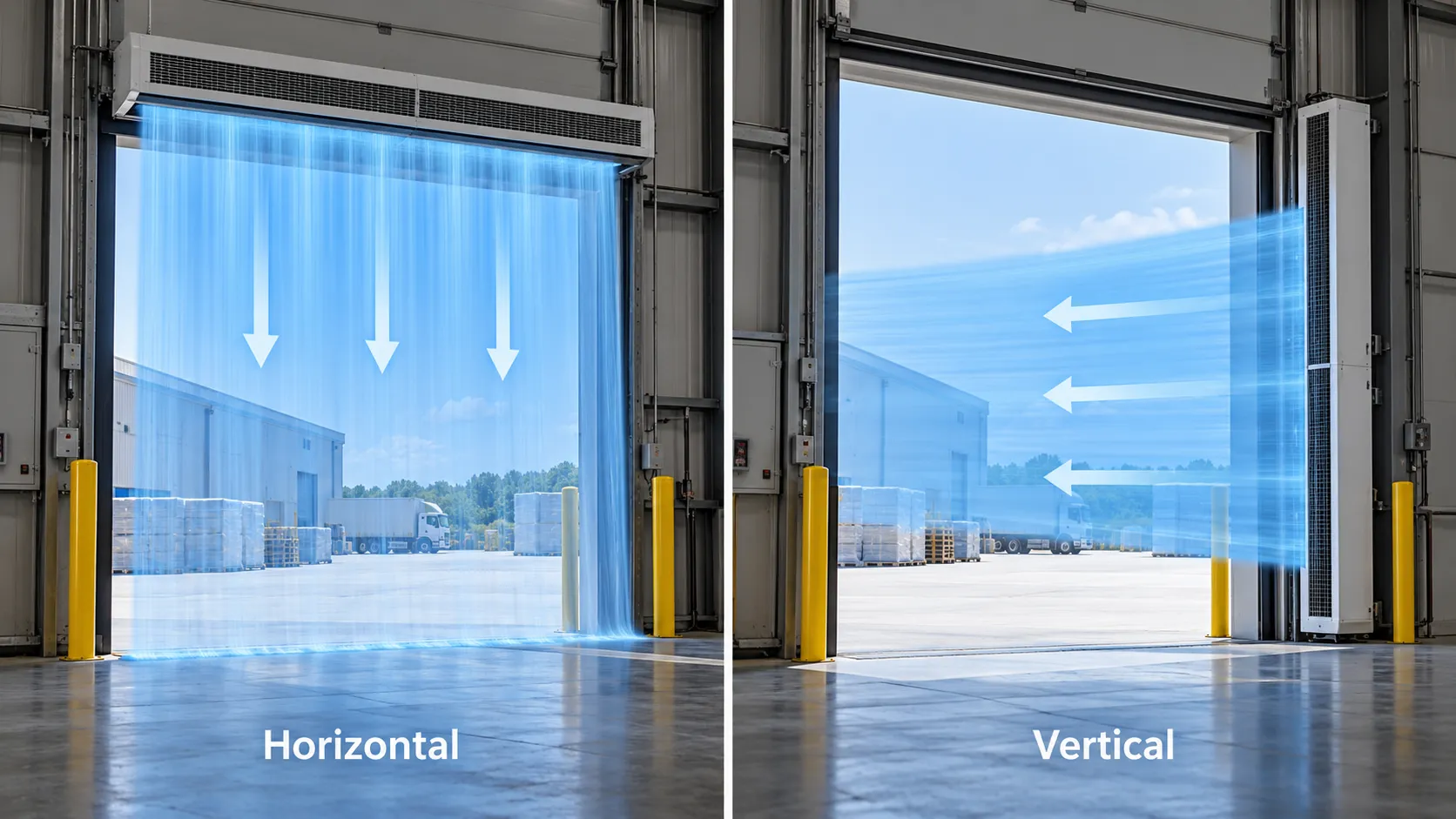
| Mounting | Header space, tracks, beams and permissible orientation | Determines whether horizontal, vertical or custom mounting is practical |
| Environment | Temperatures, humidity, wind exposure, dust, washdown or corrosion | Affects jet stability, materials and motor protection |
| Pressure | Exhaust airflow, make-up air and known pressure imbalance | A strong cross-opening pressure can bend the jet |
| Traffic | People or vehicles, size, speed, cycles and open time | Defines disturbance and recovery requirements |
| Electrical | Voltage, frequency, phase, controls and local compliance needs | Prevents an incompatible motor or control package |
| Objective | Thermal separation, insects, dust, fumes or worker comfort | Different objectives require different end-point velocities and layouts |
HUANGXI’s published G-series industrial specifications list 25 m/s maximum air speed and nominal airflow from 3,760 to 9,400 m³/h across models HFM-4509-L-GA to HFM-4520-L-GA. The current published electrical specification is 380 V, 50 Hz. Those figures make the range a candidate for large industrial openings, but they do not remove the need to check projection, width coverage and site forces.
For projects in Mexico or Brazil, provide the exact site frequency, voltage and phase. Do not connect a motor to a different supply solely because the nominal voltage looks close. HUANGXI can evaluate project-specific voltage and mechanical requirements through its OEM and ODM service.
If you are still deciding whether the application requires an industrial rather than a commercial platform, read the broader industrial air curtain buying guide. For an estimate of the energy mechanism and the data needed for an ROI model, see how air curtains reduce infiltration-related energy loss.
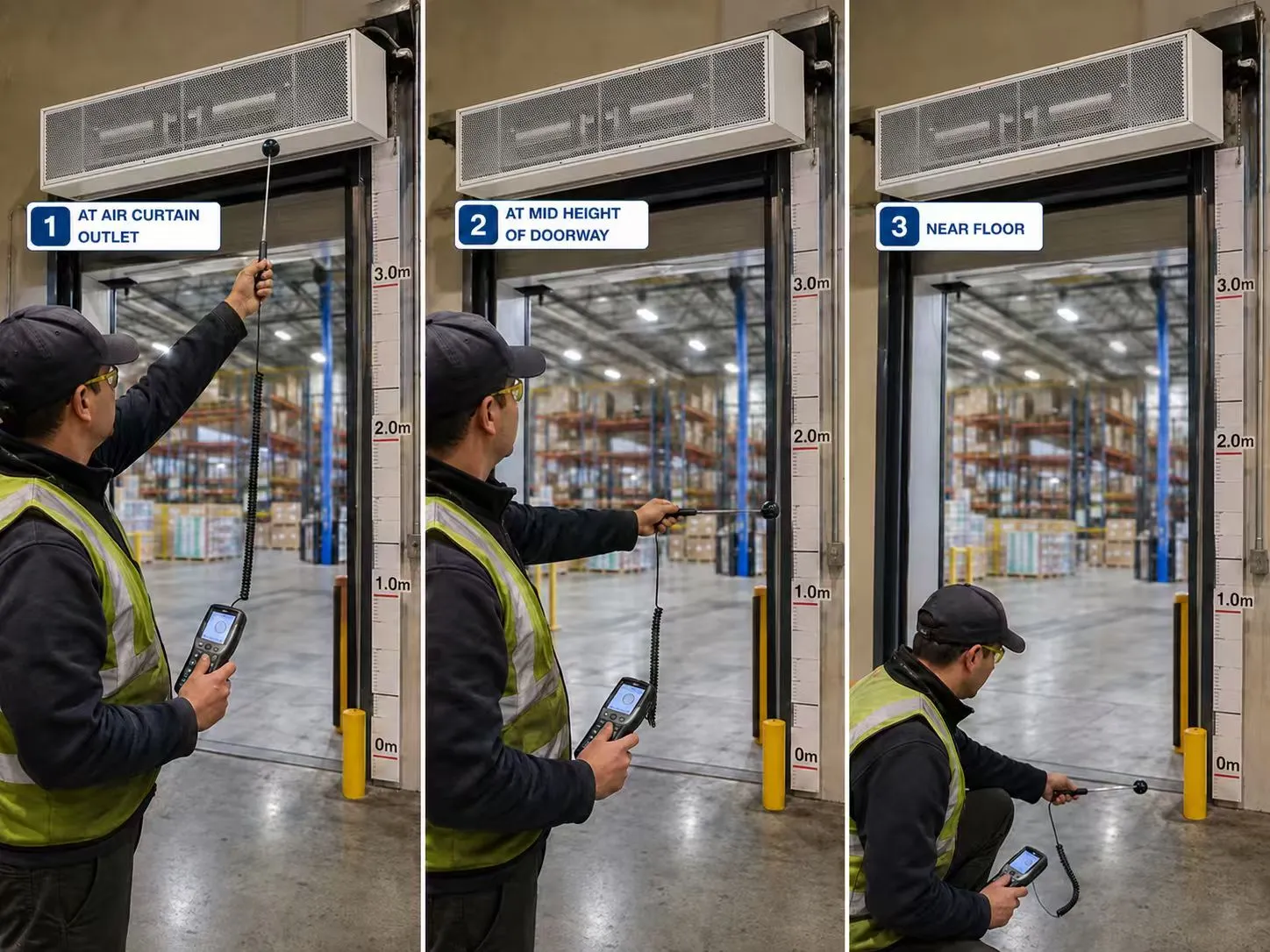
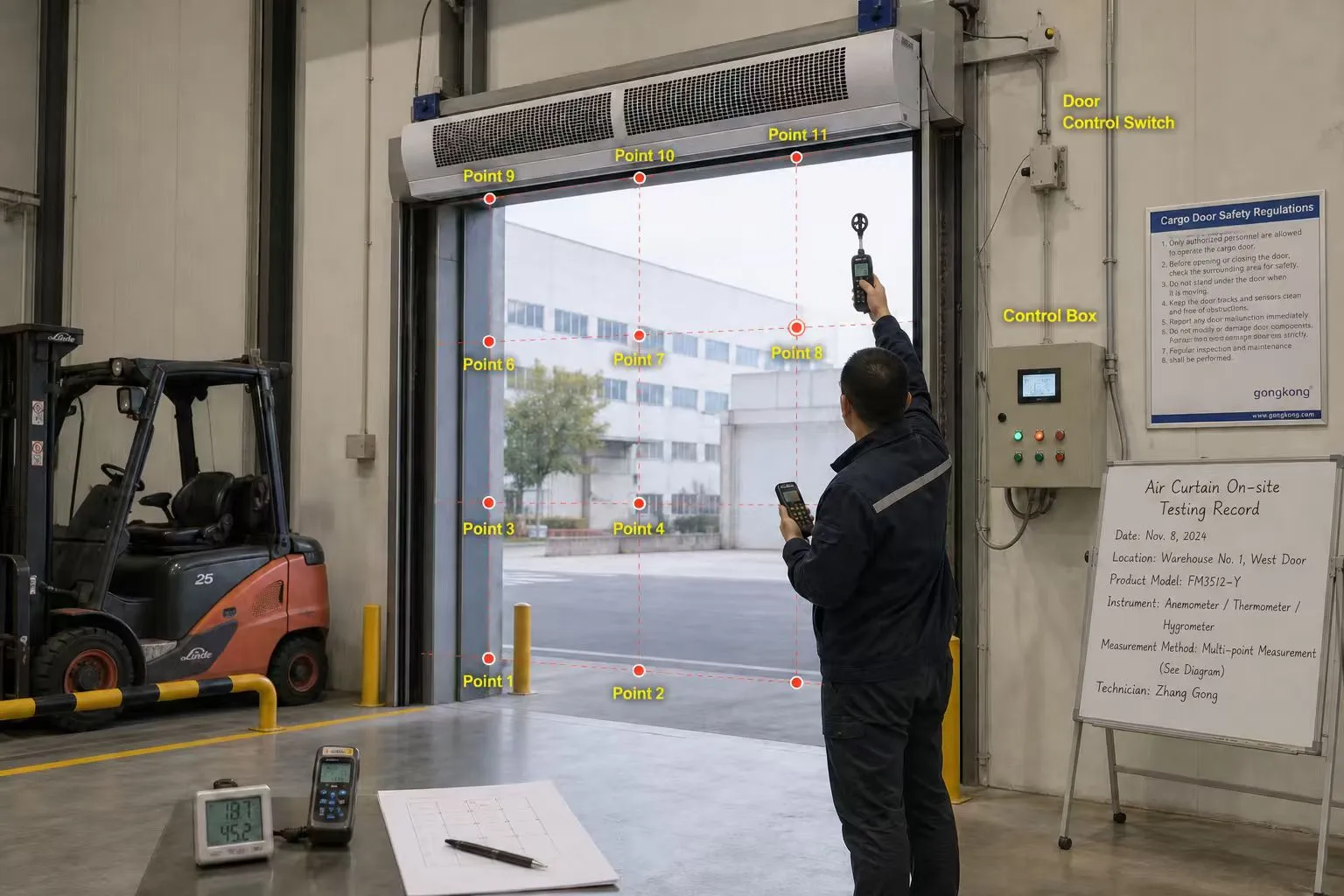
A correct paper selection can still underperform if the unit is installed too far from the opening, its nozzle points in the wrong direction, filters or inlets are obstructed, or the building is more depressurized than expected. Commissioning should verify:
The most defensible industrial air curtain selection connects laboratory performance with field conditions. Door width sets coverage; mounting height sets the throw; pressure, wind and temperature difference determine the opposing force; and traffic determines how often the jet must recover. Motor power and peak velocity are supporting data, not the design by themselves.
For a HUANGXI selection review, send a doorway drawing or dimensioned photo together with temperatures, traffic, wind exposure and electrical supply. The engineering team can then recommend a standard model, a modular arrangement or a custom horizontal or vertical solution.
The combined discharge should cover the full clear width without gaps. The final unit length and any overlap should be confirmed from the manufacturer’s mounting drawing, especially when several modules are used.
No. Compare tested airflow, velocity uniformity, projection or velocity-at-distance, power and the conditions under which the data were measured. A high peak at the nozzle can coexist with weak terminal performance.
No. Charts are useful for initial screening, but wind, building pressure, temperature difference, mounting offset and traffic can change the required duty. Large or exposed openings need a project-specific review.
Vertical mounting can suit very wide doors, limited header space or openings where a shorter horizontal jet path is advantageous. It requires adequate side clearance and physical protection from vehicles. The layout should be engineered rather than improvised on site.