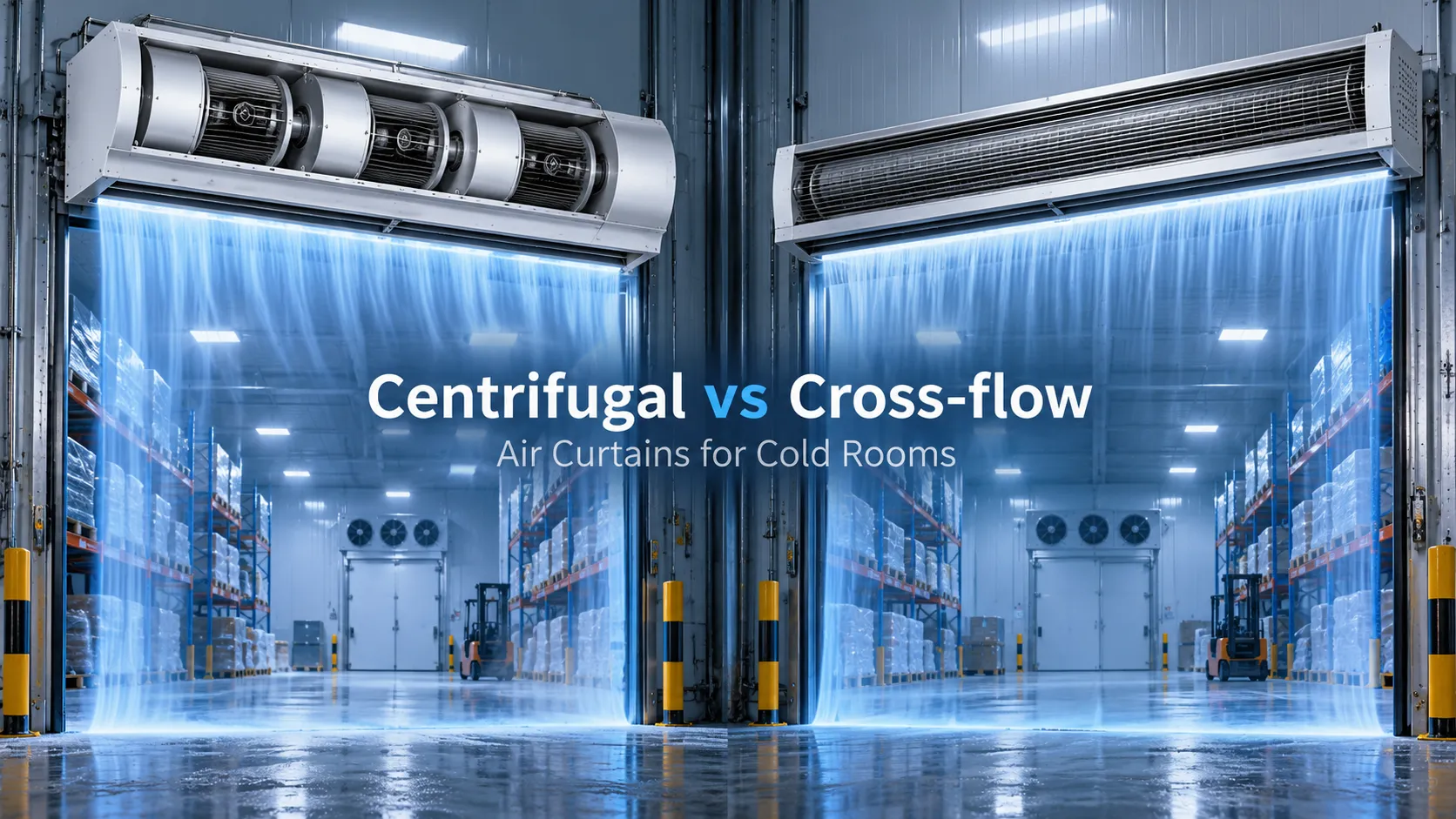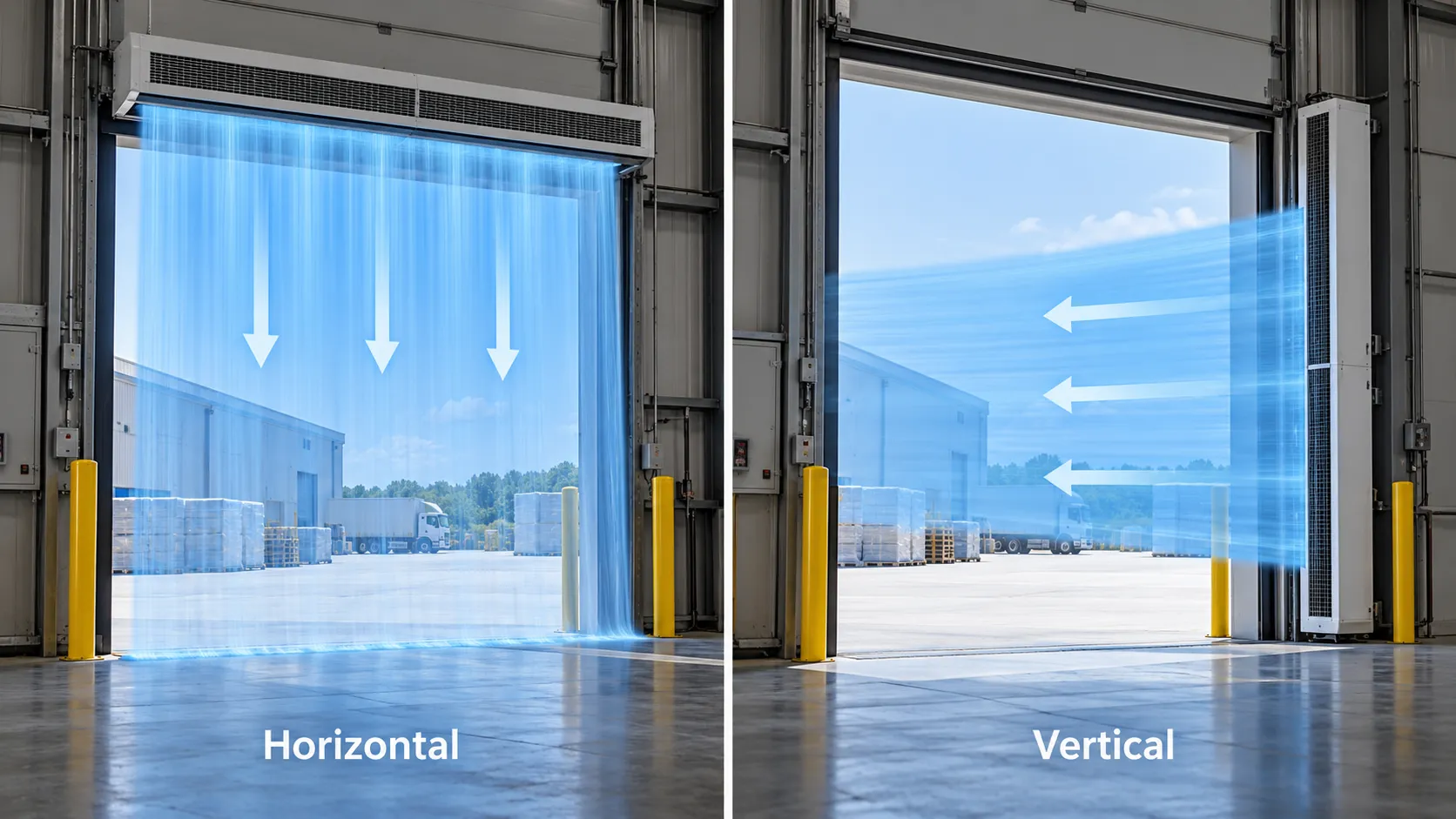
Horizontal vs Vertical Industrial Air Curtains for Large Doors
Horizontal vs Vertical Industrial Air Curtains for Large Doors Most air curtains are mounted horizontally…

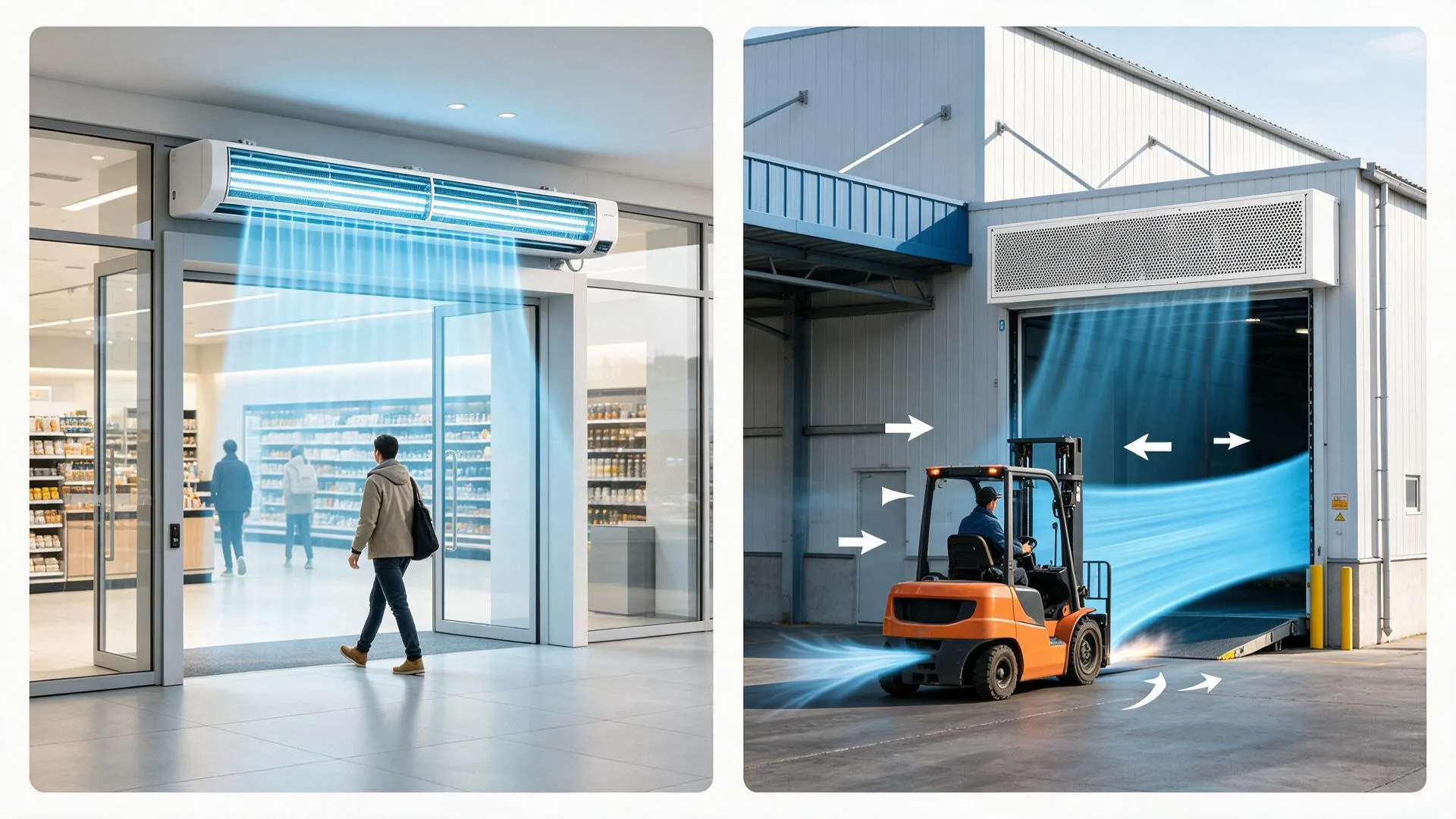
An industrial vs commercial air curtain comparison is not simply a question of which unit is larger. The meaningful distinction is the duty the machine can perform at the installed doorway: the distance its jet must travel, the forces it must resist, the hours it must run and the environment in which its motor, impeller and casing must survive.
A quiet unit designed for a 2.4 m shop entrance can be an excellent commercial air curtain and still be the wrong machine for a 5 m warehouse door. Conversely, specifying a high-velocity industrial unit at a small customer entrance can add unnecessary noise, power and cost. A defensible comparison therefore uses application and measured performance rather than product labels.
| Selection factor | Typical commercial duty | Typical industrial duty |
|---|---|---|
| Opening | Pedestrian entrance with moderate mounting height | Warehouse, factory, vehicle or loading-dock opening |
| Primary disturbance | Pedestrian traffic and normal outdoor drafts | Forklifts, crosswind, stack effect and plant pressure |
| Performance priority | Comfort, low sound and architectural fit | Jet projection, recovery, durability and service access |
| Fan and motor duty | Intermittent or moderate operation | Long operating hours and repeated high-load cycles |
| Construction | Compact housing for visible interiors | Robust casing and mounting for demanding spaces |
| Controls | Door contact, remote or simple speed control | Door logic, delay, variable speed, BMS and safety interlocks |
| Selection evidence | Tested airflow, velocity uniformity, projection, power and sound at the required duty | |
These are tendencies, not legal definitions. The installed result should determine the class. A well-engineered commercial platform may protect a sheltered opening, while an exposed industrial opening may need a custom or vertical arrangement rather than a larger version of a standard unit.
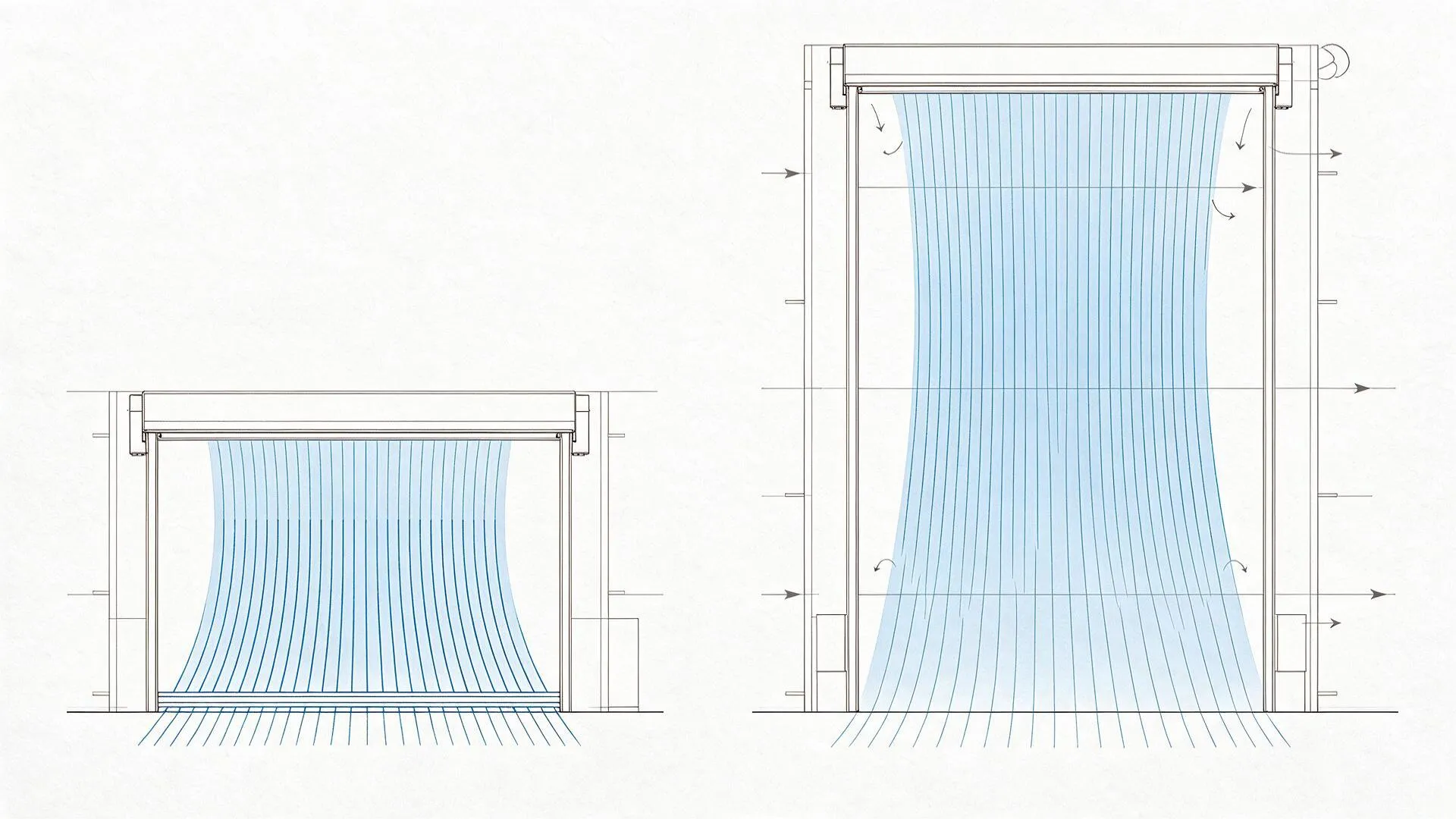
An air curtain works by producing a plane jet across an opening. As the jet travels, it entrains surrounding air, spreads and slows. It must retain sufficient momentum to reach the floor or other designed terminal point while resisting transverse forces.
Commercial entrances normally impose a shorter throw. Industrial doors often multiply the travel distance and expose the jet to vehicle wakes, wind and larger temperature-driven pressure differences. The correct question is therefore not “How powerful is the motor?” but “What measured velocity distribution remains at the required distance?”
ANSI/AMCA Standard 220-21 establishes laboratory methods for rating aerodynamic performance. When comparing offers, request data produced under a recognized method and check whether velocity is a peak, an average across the nozzle or a projection value at distance.
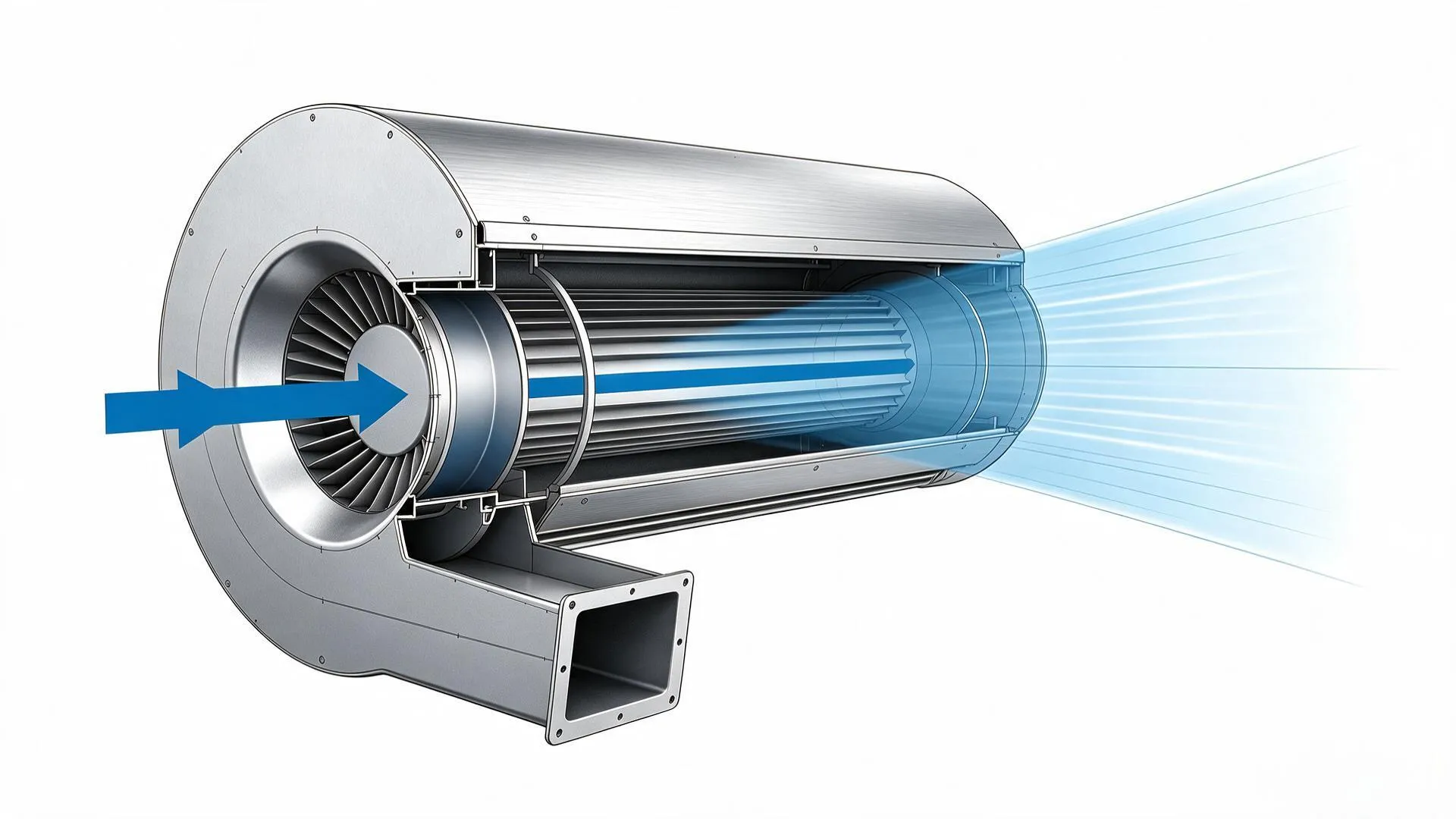
Airflow tells you the volume moved per unit time. Velocity tells you the speed at a location. Fan pressure describes the fan’s capacity to overcome resistance and maintain its operating point. None of these values should be used as a substitute for the others.
Centrifugal fans are frequently chosen where pressure capability and controlled discharge are important. However, the word “centrifugal” alone does not guarantee a suitable air curtain. Impeller geometry, casing, nozzle, rotational speed and the complete fan-system operating point determine the result.
The U.S. Department of Energy’s Improving Fan System Performance sourcebook explains that fan selection should be based on the system duty and fan curve. OSHA’s industrial ventilation technical manual similarly identifies airflow, static pressure, contaminants and noise as fan-selection inputs. In an air curtain, the nozzle and free jet are part of that system.
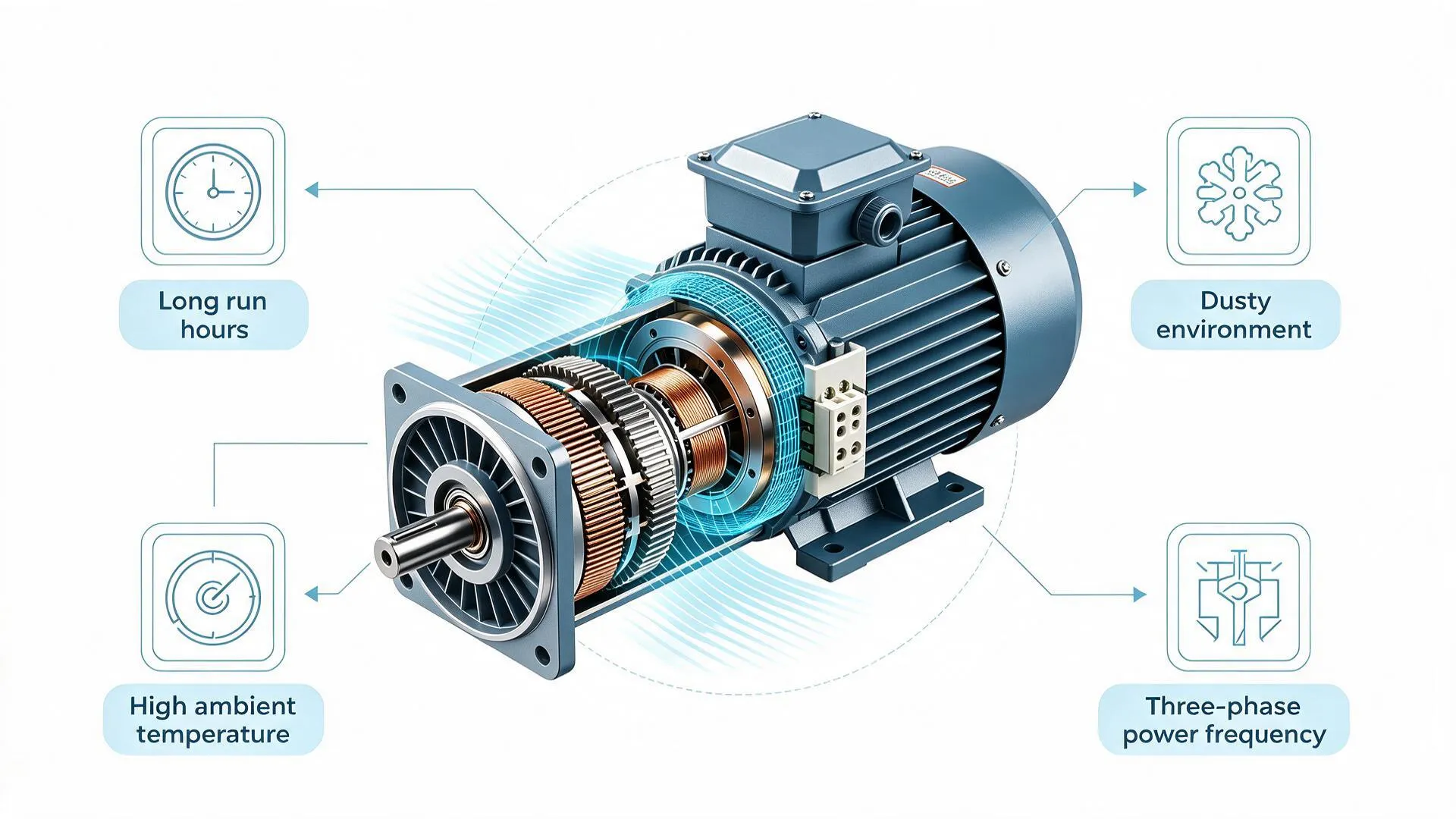
Factories and logistics sites may keep a doorway active through multiple shifts. Repeated starts, long run time, dust and elevated ambient temperature increase thermal and mechanical stress. Ask for the motor duty, insulation class, protection, bearing arrangement, overload protection and permitted starting frequency—not just input watts.
Three-phase power can provide a practical platform for larger motors and continuous industrial duty, but the electrical package must match the site. HUANGXI’s currently published industrial air curtain range is listed at 380 V and 50 Hz. Projects in Mexico or Brazil must state the actual voltage, 60 Hz frequency, phase and control voltage so the manufacturer can confirm or engineer a compatible configuration. A 50 Hz nameplate must never be treated as automatically suitable for a 60 Hz supply.
A painted steel housing may be appropriate for a dry warehouse. Food processing, washdown, coastal air, corrosive vapors or explosive atmospheres require a separate material and safety review. Stainless steel can improve cleanability and corrosion resistance, but the grade, surface finish, fasteners and internal components still need to match the exposure.
Where combustible gas, vapor or dust may be present, a standard industrial air curtain is not made safe by changing the casing. The motor, electrical equipment, temperature class and complete installation must comply with the hazardous-area classification. HUANGXI offers stainless steel and explosion-proof air curtain product categories for project discussion; the final specification should be reviewed by qualified local engineers.
A commercial entrance may need a door contact and two fan speeds. An industrial opening can require a sequence involving a high-speed door, vehicle sensor, BMS, fire alarm, exhaust system and time delay. The control logic determines whether the jet is established when the opening is exposed and whether energy is wasted when it is closed.
For high traffic, consider:
Sound is often the deciding commercial criterion at a lobby or restaurant. It still matters in industry: excessive noise can affect communication, worker exposure and acceptance of the system. Compare sound ratings under equivalent test and operating conditions. A low-speed sound figure does not describe a unit that must run at maximum speed to reach the floor.
Also distinguish airborne sound from abnormal vibration. Poor balance, loose supports or resonance can create a maintenance problem even when the original fan rating is acceptable.

Use the HUANGXI industrial air curtain range as the starting point for factories, warehouses and vehicle doors. For a broader discussion of published motor and airflow specifications, see the existing industrial buying guide.
Procurement teams may encounter the terms cortina de aire industrial in Mexico and cortina de ar industrial in Brazil. The translated category name is useful for local sourcing, but it does not define performance. Ask every supplier for the same door data, test basis, electrical configuration, fan curve or projection evidence, materials and control sequence. That makes domestic and imported offers comparable.
Local electrical and safety compliance, installation permits and service access should be confirmed before purchase. If the standard published configuration does not match the site, request a documented factory configuration rather than planning a field modification.
The right distinction is not “small versus big.” A commercial air curtain is designed around pedestrian comfort and shorter jet projection; an industrial air curtain is designed around taller openings, greater disturbance and demanding operation. Both should be evaluated from verified data at the intended duty.
For a project review, send HUANGXI the clear opening dimensions, mounting constraints, temperatures, wind exposure, building pressure information, traffic profile and electrical supply. The response can then identify whether a commercial, industrial or custom arrangement is justified.
Only if its tested projection, width coverage and environmental rating meet the actual opening. A commercial label does not automatically disqualify a unit, but most tall or exposed vehicle doors impose duty beyond a standard commercial platform.
No. Input power does not directly state jet uniformity, projection or sealing effectiveness. Compare aerodynamic data and installed conditions.
No. Centrifugal describes the fan’s flow path, not the application class. Centrifugal units can be built for commercial or industrial duties.
Not necessarily. The operating sequence should match door use and the control objective. Door-linked or demand-based control can reduce run time, provided the jet is established whenever the opening requires protection.