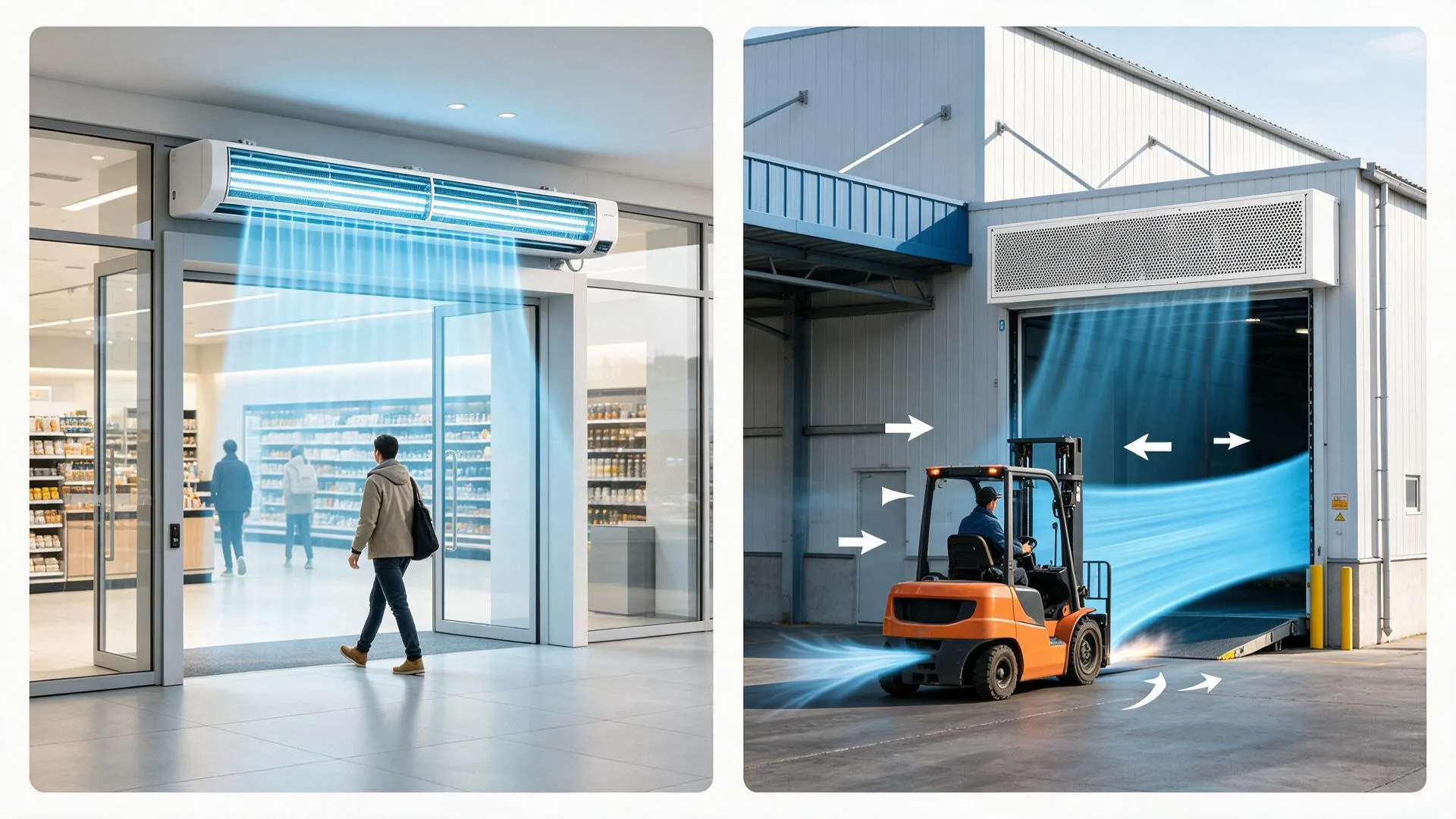
Horizontal vs Vertical Industrial Air Curtains for Large Doors
Horizontal vs Vertical Industrial Air Curtains for Large Doors Most air curtains are mounted horizontally…

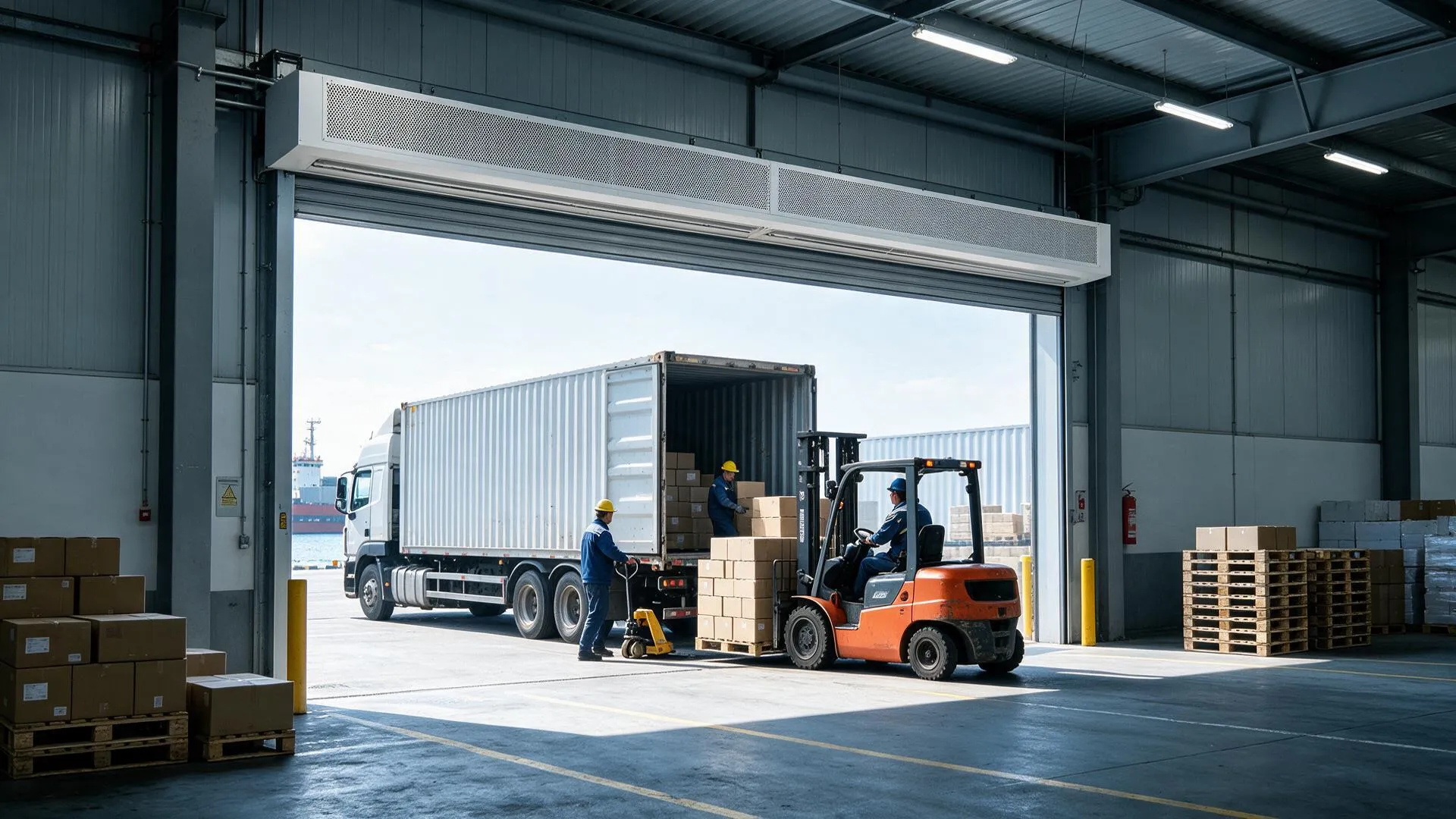
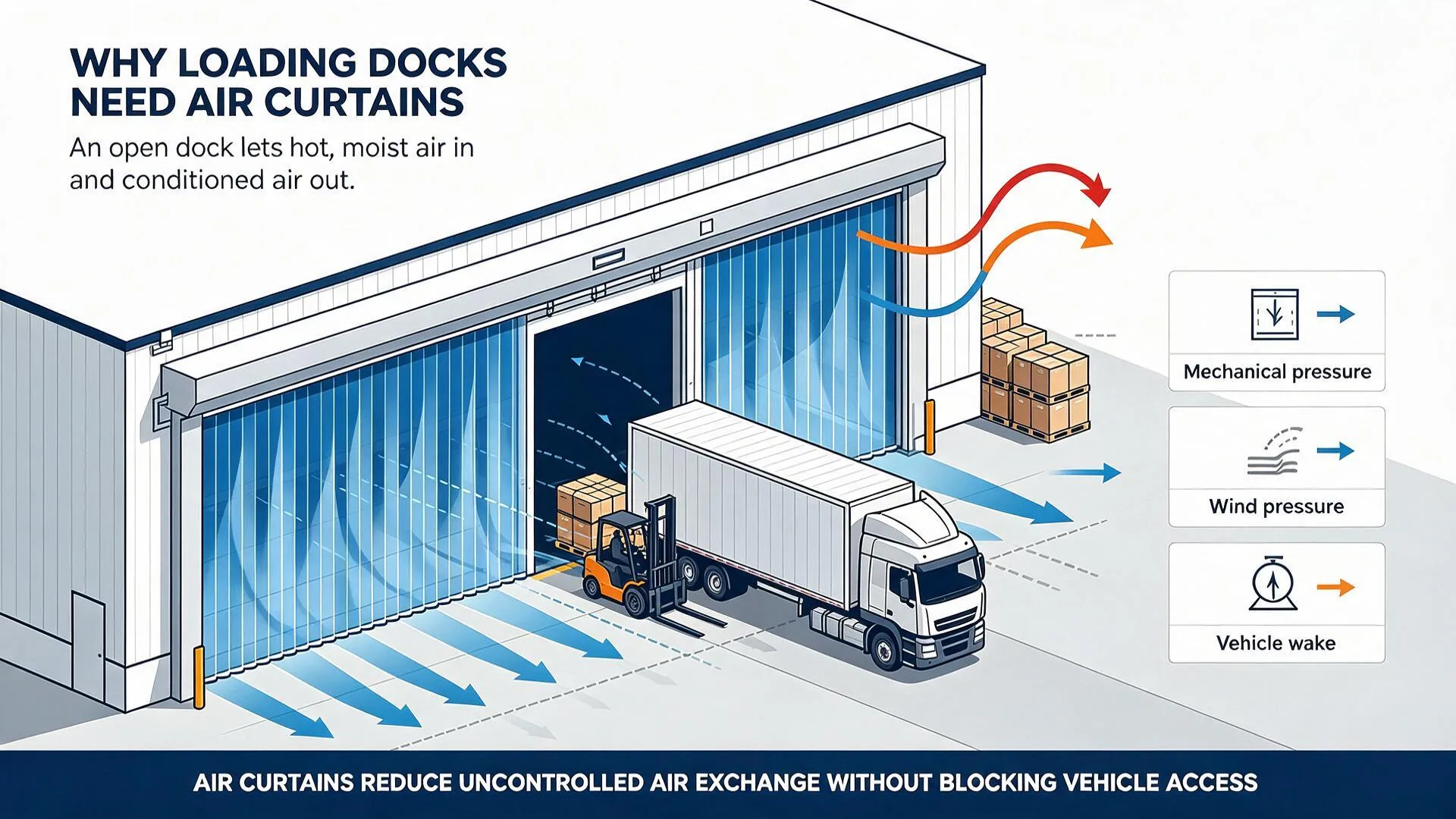
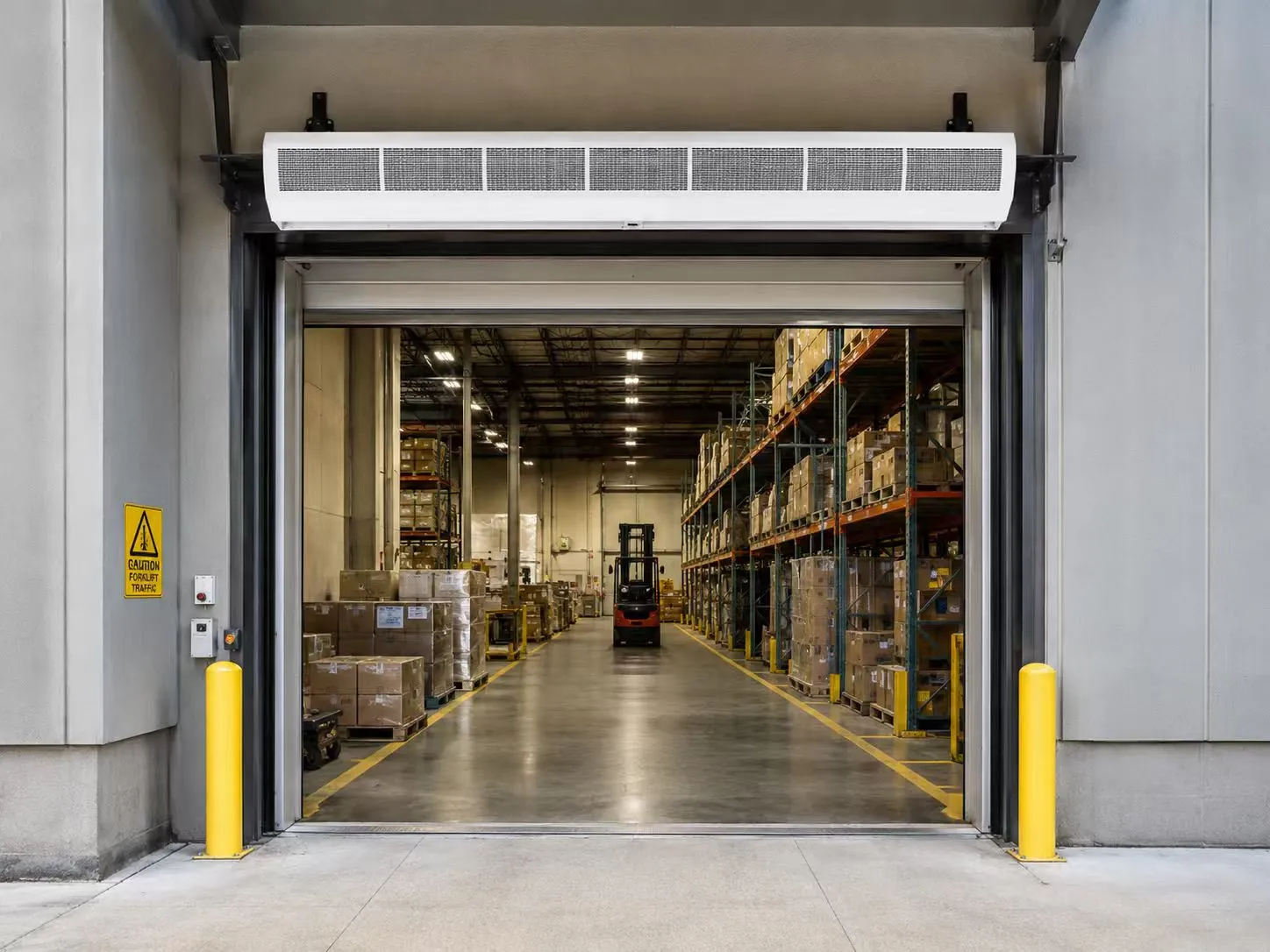
A loading dock connects two air systems that rarely want to mix. When a warehouse or production area is cooled, an open dock can admit hot outdoor air and moisture while allowing conditioned air to escape. Wind, exhaust systems and forklift movement can turn that exchange into a persistent HVAC load. A correctly specified loading dock air curtain reduces the open area available to uncontrolled airflow without placing a physical barrier in the vehicle path.
Projects in Mexico and Brazil need more than a generic “tropical” selection. Both countries contain hot-humid, hot-dry, high-altitude and temperate industrial regions. The design should use the actual site’s weather, door orientation, indoor set point and pressure state. This checklist focuses on the data that make an international air-curtain quotation technically useful.
A pedestrian entrance usually has a modest opening, short door cycle and limited wake. A dock or vehicle door may be several meters high, remain open through loading and experience frequent large-body passage. Four forces act at the same time:
ASHRAE’s room-air-distribution guidance treats pressure difference, discharge area, air density and dynamic efficiency as air-curtain design variables. This is why a unit selected only from door width can perform differently at two identical buildings.
Record the site location and the outdoor dry-bulb and humidity design condition used by the HVAC or refrigeration engineer. The peak sensible load depends on temperature difference. The latent load depends on how much water vapor enters and must be condensed or removed. A coastal Brazilian facility and a high-altitude Mexican warehouse may impose very different duties even when their daytime temperatures look similar.
The air curtain does not cool or dehumidify the incoming air by itself. Its energy value comes from reducing air exchange. Any savings estimate should therefore use the site’s operating schedule and psychrometric conditions rather than a universal percentage.

Identify the compass orientation, nearby buildings, canopies and prevailing wind during operating hours. A sheltered internal transfer door is easier to separate than a dock facing an open yard. If several large doors can be open simultaneously, cross-building airflow may dominate the behavior of any one air curtain.
Mitigation can include a better discharge angle, higher verified terminal momentum, a side-mounted arrangement, a dock shelter or a change to building make-up air. Simply increasing fan speed is not always the best answer because fan power and noise rise and the jet may entrain more surrounding air.
Food plants, paint lines, kitchens, process exhaust and dust-collection systems can place a building under negative pressure. Test with the major exhaust and make-up-air equipment in the normal operating state and repeat for important door combinations.
An air curtain is not a substitute for adequate make-up air. If the building is strongly depressurized, the doorway will continue trying to satisfy the missing airflow. Correct the pressure problem first or include it explicitly in the system design.
Provide the largest vehicle or load envelope, typical speed, movements per hour and average door-open time. A barrier that looks stable with no traffic can lose effectiveness during high-throughput operation. Research on human passage through an air curtain between different-temperature zones demonstrates the general mechanism: a moving body transports fluid and leaves a wake, and greater passage speed increases exchange.
A vehicle-door sequence should allow the jet to establish as the door opens, remain active throughout passage and recover between movements. Coordinate the air curtain with the high-speed or sectional door rather than installing two independent controls.
Do not order from a voltage number copied from a product page. The request should state:
Mexico and Brazil use 60 Hz power systems, while HUANGXI’s current published G-series industrial data is listed at 380 V/50 Hz. That does not establish 60 Hz suitability. Send the site nameplate requirements to HUANGXI for written confirmation of a project-specific motor and control package through its OEM/ODM engineering service.
A dry logistics warehouse may use a coated steel casing. Coastal exposure, fertilizer or chemical handling, food washdown and corrosive process air require a materials review. Specify ambient temperature, humidity, salt or chemical exposure, washdown method, dust and any hazardous-area classification.
Stainless steel is a material option, not a complete hygiene or corrosion specification. Define the grade, finish, fasteners and compatibility of internal components. For regulated food or pharmaceutical facilities, the installation should also avoid inaccessible dirt traps and permit safe cleaning.
The quotation should report more than maximum outlet velocity. Ask for:
ANSI/AMCA 220-21 is the relevant aerodynamic rating standard. AMCA’s air-curtain technology presentation also highlights airflow, velocity uniformity and projection as distinct data points.
| Section | Required project information |
|---|---|
| Site | City, altitude if relevant, outdoor design temperature and humidity |
| Indoor condition | Temperature, humidity target and process sensitivity |
| Door | Clear width, nozzle-to-floor height, orientation and daily open time |
| Traffic | Vehicle/load envelope, speed and cycles per hour |
| Air forces | Prevailing wind, exhaust, make-up air and simultaneous open doors |
| Mounting | Header/side space, door tracks, beams, sprinklers and impact risks |
| Electrical | Voltage, 60 Hz frequency, phase, controls and compliance requirements |
| Construction | Corrosion, dust, washdown, food hygiene or hazardous-area needs |

The published HUANGXI industrial air curtain data lists models from 90 to 200 cm, maximum outlet velocity of 25 m/s and nominal airflow from 3,760 to 9,400 m³/h. Multiple units can cover wider openings. Treat these values as screening data; the final arrangement must be checked against mounting height, wind, pressure and vehicle disturbance.
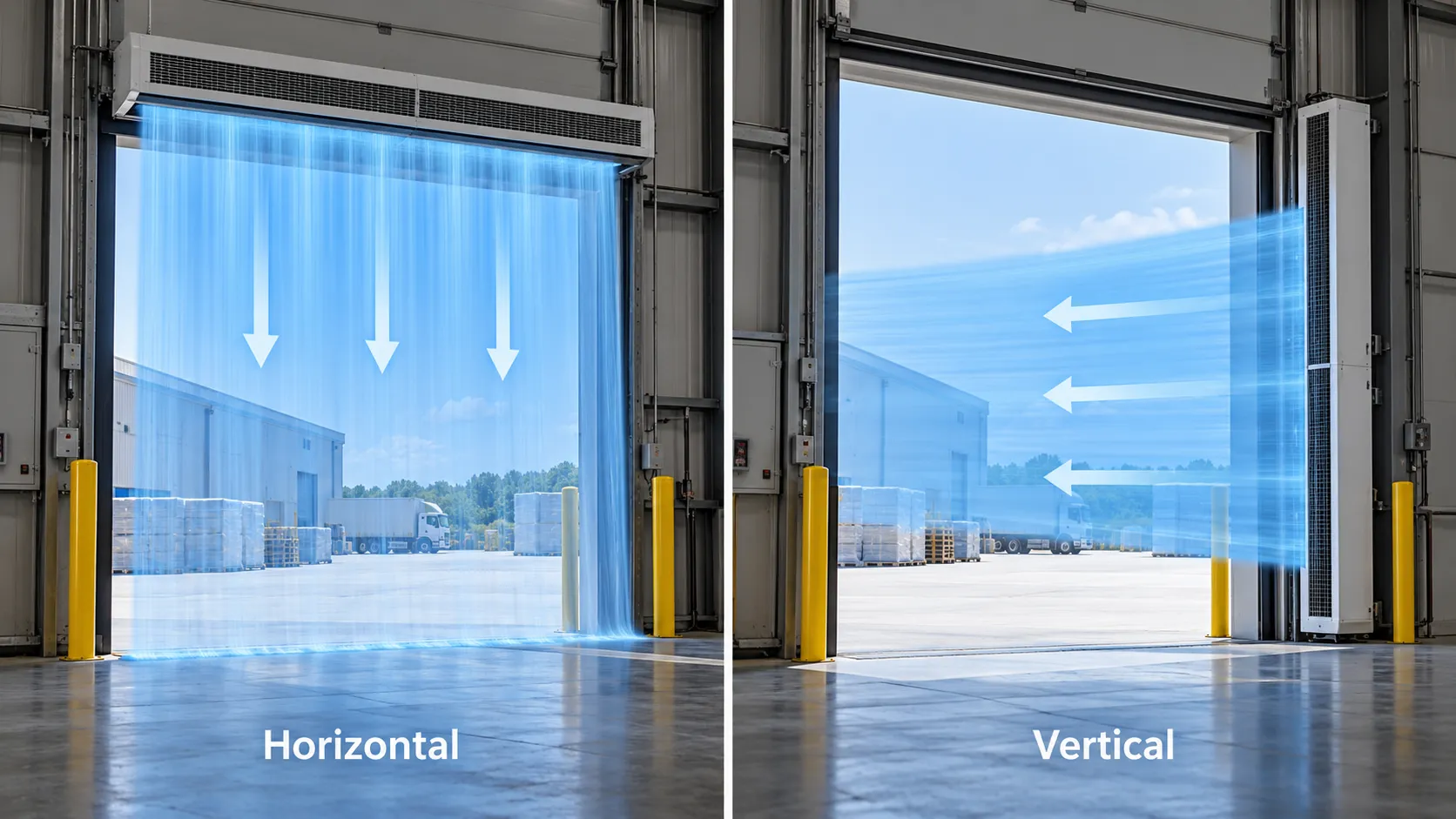
If header space is obstructed or the opening is exceptionally wide, a side-mounted design may be considered. Review the vertical air curtain category and ask for a project layout with guards and service clearances. For general model-selection principles, use the HUANGXI industrial buying guide.
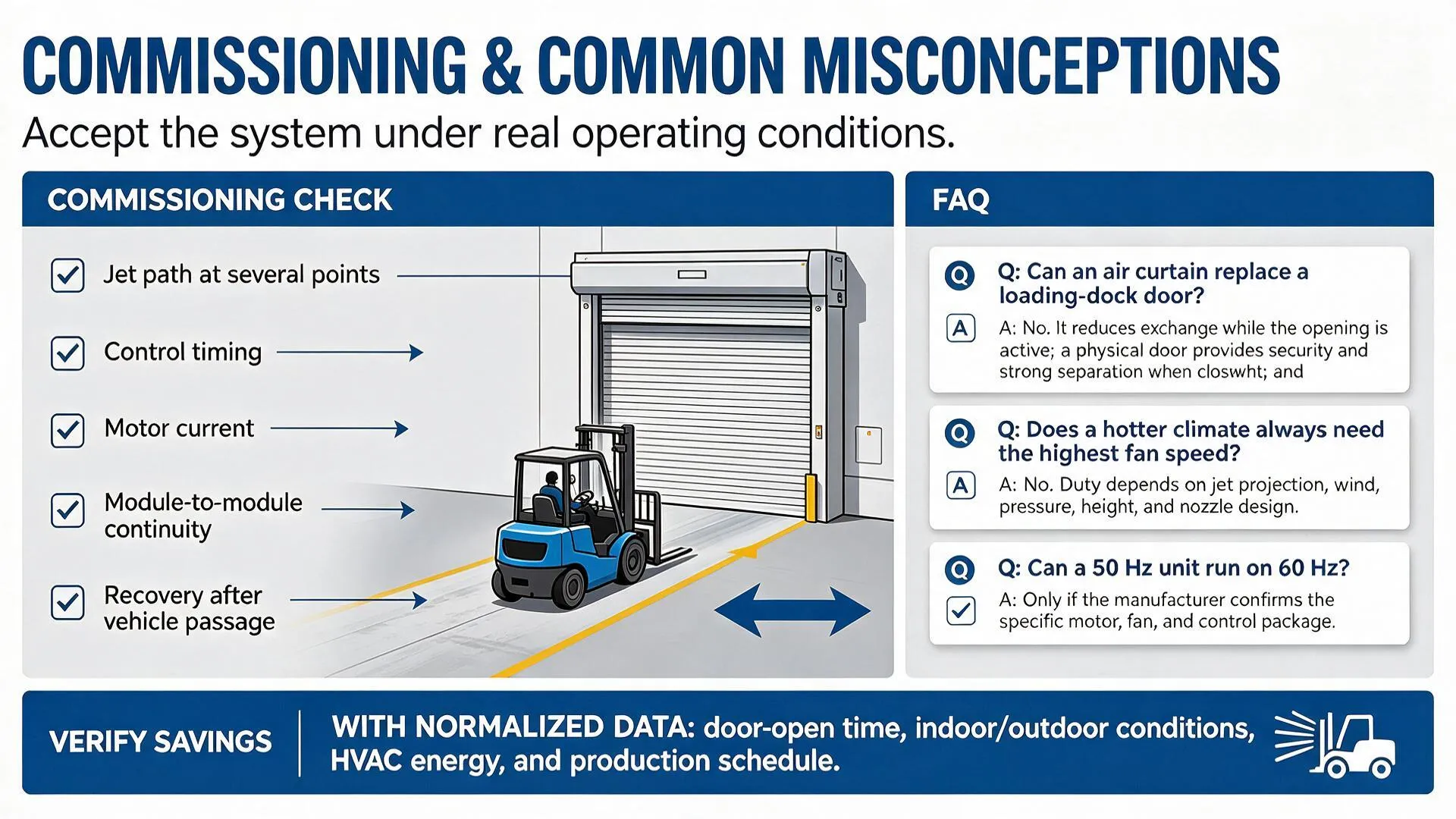
Final acceptance should include representative wind, exhaust and vehicle activity—not only a hand check at the nozzle. Verify the jet path at several points, control timing, motor current, module-to-module continuity and recovery after passage. Record baseline indoor temperature/humidity and door-open time so later energy or comfort improvements can be assessed honestly.
Buyers may search for a cortina de aire industrial in Mexico or a cortina de ar industrial in Brazil, but the engineering language is the same: opening geometry, jet projection, pressure, climate, traffic, materials and electrical compatibility. Supplying those inputs produces a quotation that can be evaluated on performance instead of adjectives.
Send HUANGXI a dimensioned door photo, design temperatures, traffic profile, wind and pressure information, and the full electrical requirement. The resulting recommendation can identify a standard modular bank, a vertical layout or a custom configuration.
No. An air curtain reduces exchange while the opening is in use. A physical door provides security, weather protection and much stronger separation when closed. The two systems should be coordinated.
No. Temperature and humidity increase the potential HVAC load, but jet duty also depends on wind, pressure, height and nozzle design. Select from measured performance and commission the discharge angle and speed on site.
Only if the manufacturer confirms the specific motor, fan and control package for that supply. Frequency changes can affect rotational speed, airflow, pressure, power and motor loading.
Compare representative periods using door-open time, indoor/outdoor conditions, HVAC or refrigeration energy and production schedule. A before-and-after result without normalization can confuse weather or operating changes with air-curtain performance.